The Universal Welshman: Interview with Ceri Rhys Matthews

Also in this edition: Gaitafolia and Featured performance:Gillian Boucher (fiddle), Seph Peters(banjo), Anna Ludlow(fiddle) and Mary Beth Carty(guitar)
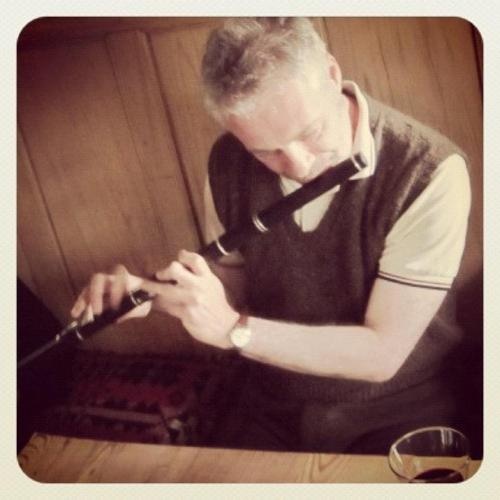
Ceri Rhys Matthews taken with Instagram

Ceri Rhys Matthews talks about what it means to be a musician bridging tradition and innovation to the fore.

The prose of Ceri Rhys Matthews flows like music. He answers questions as honestly as he can. There is a wealth of wisdom in his opinions and he does them with the ease of someone who has conversed and played music with people of varied cultural backgrounds.

My meeting with him started after hearing the music of fernhill. I was also doing research about the top pipers of Wales and his name not only came up frequently, I also got recommendations from his peers.

I am sure you will enjoy reading this informative conversation the way I enjoyed formulating my questions and reading his answers.

 You are very well known in the Welsh trad scene. How did you master the art of piping (and also the wooden flute) and who/what really influenced you  to take up piping?

A long time ago, I moved back to Wales from studying Art in Maidstone, Kent, in the east of England. This was in 1981, when I was 20 years old. There was a sound in my head that I wanted to hear but I didn’t know what it was. One night a friend said, “Are you coming to the session tonight? There’s a man coming who plays pibgorn”. And I knew instantly that that was the sound I could hear in my head, even though until then I’d never even seen a pibgorn, nor knew what that instrument was. I played mandolin at the time.

Later that summer I was playing some tunes on my mandolin, with a cittern player in a session in pub in Pontardawe, and the pibgorn player came and sat about a yard from us staring and listening intently. “Where do you get your tunes from?”, he asked, and I told him. “Hmm”, he says “Owain Alaw, check out Owain Alaw”. I already knew that repertoire I told him, and we got talking. I asked him if he’s make me a pibgorn, and so he did. Jonathan Shorland is his name and he’d been making and playing the instrument in Aberystwyth for a couple of years before we met. Anyway, we struck up a friendship and I’d visit him at his workshop and play tunes at his house and at sessions. I watched how he played, and listened and copied. He played flute too, and that’s when the flute began to seduce me.

Some years later I was more in love with the flute than the pipes, and so
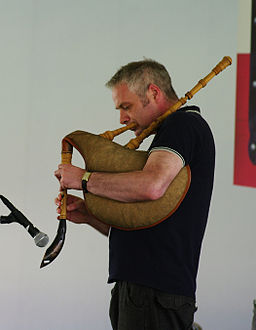
Ceri Rhys Matthews playing a Welsh Bag-Hornpipe or Pibe Cyrn

tentatively moved over to that instrument more.

What I play on both instruments is driven by two disparate things. The first is the desire to copy things that I hear and like. I’m pretty bad at this. I pick up all the wrong habits, and I’m very, very slow at learning other people’s tunes. The second is a desire to realise sounds that I hear distantly in my head. Then there is the process of focusing these nebulous sounds to make them more concrete and memorable – but still retaining a freedom each time they’re played. These two thing correspond roughly to what people would term traditional in the first instance, and creative in the second. But I see them as pretty close activities.

What can we expect from fernhill this year?

We have now enough new songs and tunes to make a new album. But money is very tight and we can’t afford to record another album in the foreseeable future. We are gigging, and playing the songs to people, and this is very important to us; to keep the flow of the music moving, and so I guess that some of these pieces won’t get recorded, as new songs take their place in our performances. Songs seem to have their time, and then move on. Sometimes, parts of old songs will find their place in new combinations, so it’s not altogether a bad thing that some don’t get recorded. But we like recording too, and so maybe next summer or autumn we’ll have another think.

I consider Yscolan as one of the best trad albums. It really represents Welsh music. When will you do a follow up to this kind of style?

Thank you. Again, I think the answer to this is pretty much like the last question. I could make many such recordings, but playing live to people seems to have taken over, and this is not such a bad thing. I have learned so much, and continue to learn from playing music to people. If an offer came from someone to make a follow up recording, I could do it next week, but I don’t expect an offer, and so I get on with playing. The playing changes and flows because of this, which pleases me.

Apart from your gigs with fernhill are there other collaborations you do?

Out of the solo work, and the fernhill work, has grown my work with Christine

Photo by Christopher Levy

Cooper, who plays fiddle for fernhill. (She’s also a storyteller in her own right).

I am coming to think that duet playing is the pinnacle of what I am working towards in my music, and Christine is helping make this more apparent to me. It helps that she is such a talented and also an understanding musician. Her musicianship is subtler than mine, and enables a very workable collaboration. In it, I tend to be a starting point; and idea or melody, and Christine helps embody or realise the idea or vision.

When two melody lines play almost in unison, something more concrete manifests to the listener, and the players. They create a triangle, but a fluid moving narrative of three points. A solo performer can create a hierarchy between himself and the audience, which is not always bad but is something I’m less interested in. The relationship between two independent but related performers, on the one hand, and the listeners on the other seems to me to be a sort of artistic democracy that is central to folk music, and that gives it wings to fly. The players can respond to each other and the listener, who in turn can influence what is being played.

Christine and I have begun to develop this recently in a thing I call “Rambles through Tunes”, which is described pretty well by Kate Pawsey here:
http://yscolan.tumblr.com/new_work

and here:
http://www.folkradio.co.uk/2012/10/ceri-rhys-matthews-rambles-through-tunes/

It’s not a new idea, of course. Or my idea. But an idea that has gripped me.

What is the state of the Welsh trad scene right now in your opinion?

It’s a complicated question. One could begin by asking, like the historian Gwyn Alf Williams asked, “When was Wales?”, and by extension, “What is Wales?”

I see the tradition(s) and the creative urge here in this place as part of a continuum of musical activity throughout these islands and beyond – to the continent, and further afield still. Much of what I have learned personally as a musician, for example, has been abroad. Surely the experience of musicians throughout the ages. I learned about the guitar in Uganda, in Africa, even though I started to play in Swansea. I learned about the pipes in the Atlas Mountains, and the mountains of Sa Pa in northern Vietnam. I learned about how you make music long instead of short from Hungarian musicians in Pontardawe (the same time as I met Jonathan Shorland).

So I feel uncomfortable when music is defined by geography, let alone nationhood. But so as not to duck the question, I feel that at the moment the music is being politicised to serve a national identity, which will ultimately strangle the music. This is not the first place this has happened in, and not the worst, and it won’t be the last. If I have a role, it’s to make sure that space and freedom are found for individuals and small groups of people to continue their personal musical narrative, and simultaneously for them to be able to breath creatively within their society, and consequently to contribute their music back.

But it’s handy to have a name for the place, otherwise people end up somewhere else if they come and visit! And so it’s possible to say that where I live has many many exciting and interesting things happening musically and culturally.

Fernhill live at Theatre Moliere, Brussels, January 2010. Fi Wela, “I See”
Julie Murphy – voice
Ceri Rhys Matthews – guitar
Christine Cooper – fiddle
Tomos Williams – trumpet

Ceri Owen-Jones on the harp and the well-known Ceri Matthews on the Welsh pipes.

Additional sources:

http://yscolan.tumblr.com/

https://twitter.com/yscolan

***

Featured video:Portuguese bagpipers Gaitafolia- Passeado Valsado

These musicians are amazing!

***

Featured performance:Gillian Boucher (fiddle), Seph Peters(banjo),Anna Ludlow(fiddle) and Mary Beth Carty(guitar)

Intense performance! More here: http://www.thecelticumbrella.com/
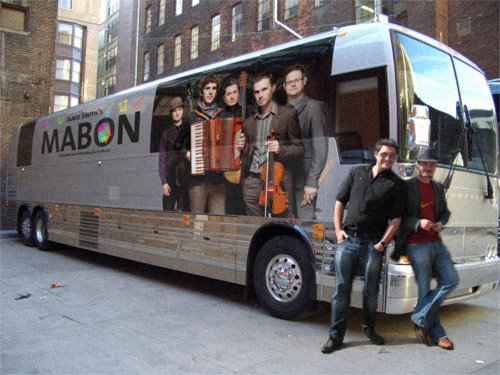
Jamie Smith’s MABON in South of Wales this Summer! Thursday, 19 July 2012

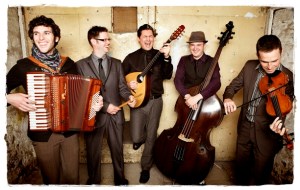
Bout this pic: Adam and Matt modelling the new tour bus. A slight upgrade from the last one!
— with Matthew Emyr Downer, Jamie Smith, Adam Rhodes, Oliver Wilson-Dickson and Iolo Whelan.

Welsh readers, get ready for J S Mabon @ The Muni!Thursday, 19 July 2012.

Apart from the much anticipated new album from this amazing Welsh band, fans in their homeland will be thrilled to see them perform live.  Here is the news event posted by Iolo Whelan, the band’s  drummer:

Our only ‘home turf’ gig this summer – come out, South Walians!
Ein unig gig lleol haf yma – dewch yn llu!

Jamie Smith’s MABON emerge from the recording studio, blinking in the daylight, and champing at the bit to play for real live people again! Tucked in amongst a list of UK and European festivals, our only local gig this summer will be at THE MUNI CENTRE, PONTYPRIDD on Thursday 19th July.
We’d be delighted if you could spread the word, and join us at this great venue for a intimate evening of music. (:

Wele Mabon yn ymddangos o’r stiwdio recordio i chwarae ein unig gig lleol yr haf yma, yng NGHANOLFAN Y MUNI, PONTYPRIDD, nos Iau 19eg o Fehefin.
Fasech chi gystal a lledaenu’r gair? Basai’n hyfryd eich gweld chi yno! (:

Be part of the event here: https://www.facebook.com/events/362339267168366/

This is an aside but that bus looks inviting! That band’s poster is also amazing. They surely hired a great photographer.

Jamie Smiths Mabon perform The Tale of Nikolai, The Dancing Bear at Priddy Folk Festival 2012

Chat with Iolo Whelan of Jamie Smith’s MABON

Jamie Smith’s MABON:  Concerts, changes and the new album.

I posted my first article about Jamie Smith’s MABON in May 5,  2010. Back then the band were known as Mabon. They  appeared in  posts as it is hard not to notice them. Everyone  was either tweeting about them or just posting status updates with youtube videos of the band.

The music is a mix of all the influences from the seven Celtic nations. That is why apart from being a Welsh band , they officially label themselves as playing  original, Interceltic, world music. To quote from the band: ” it draws inspiration directly from the traditional folk music of the Celtic countries. This is not Welsh music, nor Scottish or Irish; this is Interceltic music, a true exploration of forms and styles found in Celtic music and their forging into something bold and new.”

It is interesting to observe how this band continue to grow in their sound. After three albums(one is  alive concert)  they are working on the latest album. It is an honor to catch up with Iolo Whelan the drummer and official spokes person for the band to gather thoughts that very few know about yet. I am glad to know one thing and that is(sound of trumpets)……the name of the new album!

Band members

Jamie Smith – Accordion, Oliver Wilson-Dickson – Fiddle, Adam Rhodes – Bouzouki, Matt Downer – Electric & Upright Basses, Iolo Whelan – Drums and Percussion: Calum Stewart (special guest) – Flute & Pipes


Iolo interview answers for The Celtic Music Fan, May 2012.


Website: www.jamiesmithsmabon.com   FB: www.facebook.com/jsmabon


What’s the best part about touring with the band?

We are very fortunate in this band that we get to travel: as well as touring in the UK, which I love, we’ve also traveled in Europe, Canada, Australia and Mexico.  When we travel, we meet so many wonderful people, and see so many amazing things.  I always feel when you visit another country as a working musician, you see a very different picture than if you were a tourist.

As a brilliant example, I remember the first time we went to Poland: we were in the country for less than 24 hours, but by the time we left, I felt as though I had had an amazing insight into Polish life, Polish culture, Polish people’s lives, which will stay with me for ever.  It’s the same everywhere we go.

And apart from the travel of course, there are two obvious but very important things which I love about working in this band – the friendship and the music!  Playing with great musicians who are also your friends makes any performance a joy.

Tell us about the new project you are working on at the moment.


For us, this year is all about our new album, Windblown.  We were preparing  new material in the winter, and we’re recording it over spring and summer ready for an album release tour in the autumn.  Our last album was recorded live, so it’s a while since we were in the studio, and it’s interesting to see how things have changed.

The biggest change is the inclusion of songs in our repertoire now as well as the established instrumental aspect.  I was interested to see how the two things would sit side by side on the new album: and I think because we treat our songs the same way we treat our instrumental material, they form one unified collection very well.

We’re very excited about the way it sounds so far and can’t wait to get it out there for our friends and fans!

Has there been a change in the traditional Welsh music scene recently and what are they?


I think if there is a change in the traditional music scene in Wales today, it is a new confidence amongst musicians and bands.  I feel that more bands are happy to do their own thing and chart their own course.

Some are returning to the roots of the music and further exploring that material at its oldest sources; some are still mixing traditional material with rock and pop influences; others are exploring new realms of fusion with a broader palette of genres.  Our approach is to work without a specific niche or brief, and to make music as we fancy, taking in different influences from all the great music we hear, and seeking whatever sound we enjoy in our own original music.

Maybe that confidence in the Welsh folk scene is reflected in the appearance of more Welsh roots bands on the world music stage: Jamie Smith’s MABON, 9Bach, Calan, Burum, Catrin Finch and others are appearing more often on international stages now.  Indeed, I think some of these bands receive more attention on roots and world music platforms internationally than they do in Wales – maybe with time that will change too!

How do you define the music of Jamie Smith’s MABON and what are the things we will be expecting from the band this year in terms of concerts and collaborations, if there are any?


We describe our music as original, Interceltic, world music.  Original because, even though we work in a roots field and with trad music influences, our music is mostly composed by our accordionist and lead vocalist Jamie Smith; Interceltic because our primary influences are the cultures of all the Celtic nations; and world music because we do not feel we need to restrict ourselves to that field, and because our brand of original roots music sits so well on a world music stage.

Our main focus for this year is our new album, as I mentioned, and while that keeps us looking inward for a while, we will also be featuring several new and established collaborators on the recording.  Old friends Calum Stewart and Will Lang will contribute on wooden flute and on bodhran respectively, but our friend and recent collaborator Tom Callister will be guesting on the album too, as well as some other very special musicians yet to be revealed.

We’re hoping, after some festival appearances this summer and our album launch tour in the autumn, to be taking plenty of bookings for 2013’s festival season.  Hit our ‘Like’ button on Facebook or bookmark the concerts page of our website, and you can you can keep an eye out for a gig or a festival near you this year, next year and beyond!

You are the skins man and what can you tell us about the drums that we don’t know yet?


I often say that mine is the best seat in the house for any concert, but a Jamie Smith’s MABON concert in particular provides really interesting challenges.  For me, I feel my task is to support the melodies and the songs without getting in the way.  The sound of the accordion, fiddle and bouzouki is so full that it can be easy for the bass and drums to distract from that fullness, without adding anything special in its place.

So I tread a fine line between lifting the music and spoiling it, and I enjoy having to make those decisions from one moment to the next: I hope I get it right enough of the time!  There are many challenging roles out there for a drummer, but I’ve been doing this gig for twelve years now, and it’s still constantly stimulating, and fresh and somehow different every time.

One of our most faithful long-term fans told me last year that he can listen to us play a piece of music which he’s heard countless times before, but will hear something new or different in it each time he sees us perform – that gives me great inspiration for every concert we play.

You can buy albums of the band here: http://www.jamiesmithsmabon.com/shop/

Today in the Celtic world….

New album from an American harpist!

Congratulations to harpist friend Scott Hoye for releasing the album called Black Rose today! Listen and buy the album here: http://www.cdbaby.com/cd/scotthoye

Abagail Grey;Visually Explosive

Celtsmith is a Welsh band led by Derek Smith . Looks familiar? Well that’s because he is directly related to Jamie Smith of Jamie Smith’s Mabon. He is also the  Festival Director and chair person  of Cwlwm Celtaidd, the voluntary organisation that organises the festival under the Porthcawl Interceltic Festival since 2002. Celtsmith is a band to watch out for.

Highly emotive and explosive as icicles in March Abagail Grey, a project by Scottish singer Claire Campbell takes a daring direction in terms of style and interpretation. Her music is very visual and listening to her is like looking at shifting scenes of landscapes when you ride a train long distance. She has perfected the command of atmosphere. Incorporating beats in her music creates a balance that teeters between introspective mood and popish excitement. Elegant as chandeliers on castles yet powerful in an arena rock glamour kind of intensity, Abagail Grey has capture my ears…and heart.


Get more info here: http://abagailgrey.com/  and oh might want to check her interesting blog: http://abagailgrey.typepad.com/abagailgrey/

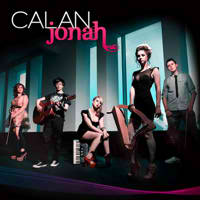
Calan is out with Jonah

These days I feel I am a bit behind my usual posts. You know why? It is because I am getting updates from left to right. There are amazing artists and the scene is flowering like never before. The support for young acts is tremendous if you think of all the forums and facebook groups sprouting in hordes.  I met amazing people in The Celtic Link forum lately and it is really a fun experience when you get info from the musicians themselves rather than just getting your news material from writings and other reviews.

Yesterday I featured Welsh band Fernhill. Now I am going to present Calan, which I mentioned came from the same source. This band is not only slick in their interpretation of traditional music but also they have  a knack for representing themselves in a way that leaves an impression to first time listeners. It is remarkable how bands these days not only take advantage of technology but also the way they represent themselves image wise.

Calan released their debut album “Bing ” in 2008 and since then they attracted warm responses from critics. Tours, rave reviews and enthusiastic audience are around always  looking for more music that these guys can take out like pancakes. The new album is called Jonah. Listen to sound samples here: http://www.calan-band.com/english/music.html

Band members:
Patrick Rimes – fiddle, bagpipes, pibgorn, whistle, trombone

Angharad Siân Jenkins – fiddle

Bethan Rhiannon – main vocal, accordion and step dancing

Alaw Ebrill Jones – harps

Llinos Eleri Jones – harp, triple harp

Sam Humphries – guitar

Alex Moller – percussion, drums