I said several hours ago, that I am excited to check the inbox of The Celtic Music Fan Facebook page. You just don’t know what’s coming in (although you have a control of what’s going out). So this is what I got. A group of young musicians from Wales. They are already accomplishing their civic/charitable activities at a young age. I think this is amazing in an time where a lot of teens would demand for the latest iPhone or Go Pro camera. These artists are attuned to a higher calling and I wish them well and looking forward to their growth as artists and individuals. I posted the message below:
“Happy greetings from Wales-based Celtic-Classical Crossover band, The Meadows! 🙂 Here’s our version of the Traditional Irish piece, Toss the Feathers: –https://youtu.be/7N7AAtErl9w It was filmed on November 2014 at St. Teilo’s Church, Llandeilo during our Wales Air Ambulance fundraising tour. Come and ‘like’ us on our Facebook page: –www.facebook.com/TheMeadowsMusic We welcome subscribers to our Youtube channel: –https://www.youtube.com/channel/UCeiZOSVzBTYY_YyKDOLiVbQ (Or search Youtube for ‘The Meadows Cymru’ or ’The Meadows Wales’) Cheery wishes, The Meadows“
Hypnotic, soothing and beautiful. It is always a blessing when musicians reach out to CMF to let me hear what they are doing. Wales is the homeland of Serundal, a duo composed of David king and Maxie. Maxie reminds me a bit of the lead vocalist of another Welsh duo Ceredwen. But Serundal’s songs are less wispy and more organic.
Like their New Age peers, Serundal relies heavily on atmospheric tunes and steady beats. These aspects give each songs room to breath on the part of the listeners. Whither you want something soft to play on the background while doing something else or you really want to dissect the mythical inspirations behind the tracks, Serundal has them.
Stone of Destiny, The Hag of Winter, White Stag and The Water Dance are among the best examples of their captivating sound. Their music can be described as electronic/New Age with songwriting structure heavily influenced by folk music. You can sample more of their tracks if you go to their CD baby page http://www.cdbaby.com/Artist/Serundal.
UK Songwriting Contest 2010 four tracks submitted- Three from ‘Land of the Sixth Moon’ one from ‘Yule’ all voted semi-finalists 2010. 2009 Semi-finalists in the UK songwriters Contest for ‘Lady of the isles’
Members … David: producer/arranger/multi-instrumentalist/lyrics / vocals Maxie: research/ lyrics/lead vocal
Hailed by one reviewer as ‘the new Clannad’ since 2006 Serundal has produced eight full albums and two E.Ps have been released. Maxie has been a published poet since the age of fifteen, and Serundal was first born through a combination of her ideas set in poetry and David’s musical creativity. Together, born of Scottish, English and Welsh ancestry they have managed to weave together what has been described as ‘a truly magical mix of Celtic and Anglo-Saxon storytelling traditions with the energy of 21st century arrangements.’ Their music has been described as ‘timeless’ ‘cinematic’ and ‘visual’ and since 2007, they have been a featured artist on www.ubl.com Their track ‘Lady of the Isles’ (Waiting Rooms) has reached number 20 in the world chart of 521 artistes in www.iacmusic.com Through listeners votes their songs have scored highly in charts like www.songvault.fm where Serundal was the first artiste in the folk genre to have fifteen tracks on the songvault directory and to receive permanent airplay
‘The Elven Robe’ featured on Gene Godfrey’s Classic f.m www.angelfire.com ‘The Storm’ featured on Andrew John’s station on www.celticaradio.com ‘The Elven Robe’ played on Bill Everatt’s Underground www.celticaradio.com ‘Lady of the Isles’ played on Highlander radio (Live 365) www.celticradio.net ‘Snowy Owl’ on Deep Cuts radio http://www.live365.com/stations/4music2 ‘Incantation’ reached number 2 in the folk charts on www.somojo.net
Both Ab Initi (2006) and ‘Leylines’ (2007) have received excellent reviews.
Christmas 2008 saw the release of ‘Dark Days White Knights’ an album based on medieval Celtic and Arthurian legend, which has taken their musical journey into the world of progressive folk.
In the summer of 2009 ‘Lady of the Isles’ (Waiting Rooms 2006) was voted one of the songs to make it to the semi-finals of the prestigious UK Songwriter’s Contest, a remarkable achievement since this was Serundal’s first submission and there were over 6,500 entries of a very high standard.
Christmas 2009 sees the release of ‘Yule’ a special edition Christmas E.P a magical mystical blend of the Winter Solstice and the Christmas story.
Follow Serundal on twitter www.last.fm/serundalwww.myspace.com/serundalmusicwww.serundal.comwww.cdbaby.com
members of: http://www.songwriters-guild.co.uk/
***
To those who are trying to get in touched with me, I took a one month off from facebook. Please use my email joseromel.labatos@gmail.com. To current contacts all my fb messages go directly to my windows mobile but I would not be able to see your posts.
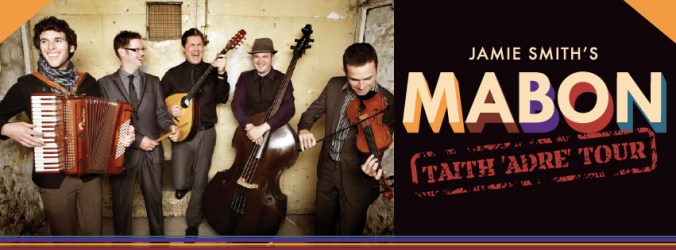
The great lads of Welsh Celtic band Jamie Smith’s Mabon is finally doing a dedicated tour all over their own county of Wales. After countless touring all over Europe the gang feels that it is time to reunite with Welsh fans and also with their own place. According to drummer Iolo Whelan:
I guess the most exciting aspect for us is that as well as being a tour *of* our home country, it also feels a bit like a homecoming – four out of the five of us live here in Wales, but we work away so often and our fans are so widely spread, that it feels a bit like we’re bringing the music home. I don’t know if that sounds pretentious, but it is making me very excited for this tour!-Iolo
And guess what. They are giving away a FREE SONG DOWNLOAD through their band newsletter. Please subscribe if you haven’t yet and feel free to download their haunting and enchanting track ‘Caru Pum Merch.’ I personally enjoyed this beautiful song which is the last track off their CD Windblown released last 2012. I also got an autographed copy of the album from all of them and I sometimes like to show it off hahaha.
The free track is a good one to point out to people too – the Welsh-language lyrics make it the most relevant to the Welsh tour, and it gives people who are new to the band a good idea of what we do, since it captures some of both the emotional and the more strident aspects of our playing.-Iolo
The band also said that in the Spring of 2014, they’ve got a joint tour of England playing about 15 venues with the young singer Maz O’Connor so watch out for that one too.Awesome update from the band through Iolo and also goodluck to the tour of your homeland! Here is the link to their newsletter where you can download the track ‘Caru Pum Merch.’ http://gmtiny.com/DSQJT/
Also in this edition: Gaitafolia and Featured performance:Gillian Boucher (fiddle), Seph Peters(banjo), Anna Ludlow(fiddle) and Mary Beth Carty(guitar)
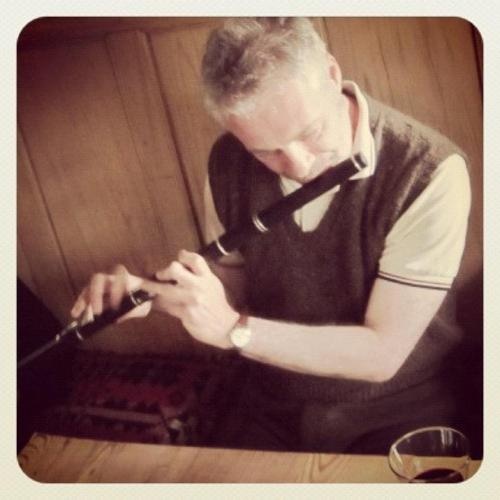
Ceri Rhys Matthews taken with Instagram
Ceri Rhys Matthews talks about what it means to be a musician bridging tradition and innovation to the fore.
The prose of Ceri Rhys Matthews flows like music. He answers questions as honestly as he can. There is a wealth of wisdom in his opinions and he does them with the ease of someone who has conversed and played music with people of varied cultural backgrounds.
My meeting with him started after hearing the music of fernhill. I was also doing research about the top pipers of Wales and his name not only came up frequently, I also got recommendations from his peers.
I am sure you will enjoy reading this informative conversation the way I enjoyed formulating my questions and reading his answers.
You are very well known in the Welsh trad scene. How did you master the art of piping (and also the wooden flute) and who/what really influenced you to take up piping?
A long time ago, I moved back to Wales from studying Art in Maidstone, Kent, in the east of England. This was in 1981, when I was 20 years old. There was a sound in my head that I wanted to hear but I didn’t know what it was. One night a friend said, “Are you coming to the session tonight? There’s a man coming who plays pibgorn”. And I knew instantly that that was the sound I could hear in my head, even though until then I’d never even seen a pibgorn, nor knew what that instrument was. I played mandolin at the time.
Later that summer I was playing some tunes on my mandolin, with a cittern player in a session in pub in Pontardawe, and the pibgorn player came and sat about a yard from us staring and listening intently. “Where do you get your tunes from?”, he asked, and I told him. “Hmm”, he says “Owain Alaw, check out Owain Alaw”. I already knew that repertoire I told him, and we got talking. I asked him if he’s make me a pibgorn, and so he did. Jonathan Shorland is his name and he’d been making and playing the instrument in Aberystwyth for a couple of years before we met. Anyway, we struck up a friendship and I’d visit him at his workshop and play tunes at his house and at sessions. I watched how he played, and listened and copied. He played flute too, and that’s when the flute began to seduce me.
Some years later I was more in love with the flute than the pipes, and so
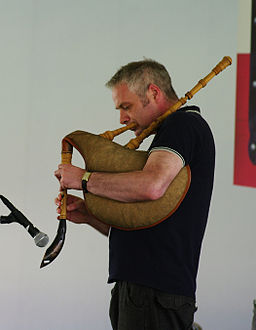
Ceri Rhys Matthews playing a Welsh Bag-Hornpipe or Pibe Cyrn
tentatively moved over to that instrument more.
What I play on both instruments is driven by two disparate things. The first is the desire to copy things that I hear and like. I’m pretty bad at this. I pick up all the wrong habits, and I’m very, very slow at learning other people’s tunes. The second is a desire to realise sounds that I hear distantly in my head. Then there is the process of focusing these nebulous sounds to make them more concrete and memorable – but still retaining a freedom each time they’re played. These two thing correspond roughly to what people would term traditional in the first instance, and creative in the second. But I see them as pretty close activities.
We have now enough new songs and tunes to make a new album. But money is very tight and we can’t afford to record another album in the foreseeable future. We are gigging, and playing the songs to people, and this is very important to us; to keep the flow of the music moving, and so I guess that some of these pieces won’t get recorded, as new songs take their place in our performances. Songs seem to have their time, and then move on. Sometimes, parts of old songs will find their place in new combinations, so it’s not altogether a bad thing that some don’t get recorded. But we like recording too, and so maybe next summer or autumn we’ll have another think.
I consider Yscolan as one of the best trad albums. It really represents Welsh music. When will you do a follow up to this kind of style?
Thank you. Again, I think the answer to this is pretty much like the last question. I could make many such recordings, but playing live to people seems to have taken over, and this is not such a bad thing. I have learned so much, and continue to learn from playing music to people. If an offer came from someone to make a follow up recording, I could do it next week, but I don’t expect an offer, and so I get on with playing. The playing changes and flows because of this, which pleases me.
Apart from your gigs with fernhill are there other collaborations you do?
Out of the solo work, and the fernhill work, has grown my work with Christine
Photo by Christopher Levy
Cooper, who plays fiddle for fernhill. (She’s also a storyteller in her own right).
I am coming to think that duet playing is the pinnacle of what I am working towards in my music, and Christine is helping make this more apparent to me. It helps that she is such a talented and also an understanding musician. Her musicianship is subtler than mine, and enables a very workable collaboration. In it, I tend to be a starting point; and idea or melody, and Christine helps embody or realise the idea or vision.
When two melody lines play almost in unison, something more concrete manifests to the listener, and the players. They create a triangle, but a fluid moving narrative of three points. A solo performer can create a hierarchy between himself and the audience, which is not always bad but is something I’m less interested in. The relationship between two independent but related performers, on the one hand, and the listeners on the other seems to me to be a sort of artistic democracy that is central to folk music, and that gives it wings to fly. The players can respond to each other and the listener, who in turn can influence what is being played.
Christine and I have begun to develop this recently in a thing I call “Rambles through Tunes”, which is described pretty well by Kate Pawsey here: http://yscolan.tumblr.com/new_work
It’s not a new idea, of course. Or my idea. But an idea that has gripped me.
What is the state of the Welsh trad scene right now in your opinion?
It’s a complicated question. One could begin by asking, like the historian Gwyn Alf Williams asked, “When was Wales?”, and by extension, “What is Wales?”
I see the tradition(s) and the creative urge here in this place as part of a continuum of musical activity throughout these islands and beyond – to the continent, and further afield still. Much of what I have learned personally as a musician, for example, has been abroad. Surely the experience of musicians throughout the ages. I learned about the guitar in Uganda, in Africa, even though I started to play in Swansea. I learned about the pipes in the Atlas Mountains, and the mountains of Sa Pa in northern Vietnam. I learned about how you make music long instead of short from Hungarian musicians in Pontardawe (the same time as I met Jonathan Shorland).
So I feel uncomfortable when music is defined by geography, let alone nationhood. But so as not to duck the question, I feel that at the moment the music is being politicised to serve a national identity, which will ultimately strangle the music. This is not the first place this has happened in, and not the worst, and it won’t be the last. If I have a role, it’s to make sure that space and freedom are found for individuals and small groups of people to continue their personal musical narrative, and simultaneously for them to be able to breath creatively within their society, and consequently to contribute their music back.
But it’s handy to have a name for the place, otherwise people end up somewhere else if they come and visit! And so it’s possible to say that where I live has many many exciting and interesting things happening musically and culturally.
Fernhill live at Theatre Moliere, Brussels, January 2010. Fi Wela, “I See”
Julie Murphy – voice
Ceri Rhys Matthews – guitar
Christine Cooper – fiddle
Tomos Williams – trumpet
Ceri Owen-Jones on the harp and the well-known Ceri Matthews on the Welsh pipes.
Mike Parker 16thC. style gothic harp with bray pins on some notes. Bass ronde misattributed to Beatrix of Dia,
I heard Bill Taylor perform music using his bray harp (also known as gothic harp) and it was something. These harps sound like they are buzzing when you play them. So totally different from the harp sound we came to know. According to the BBC 3, these harps were popular among the Scots of the lowlands and this was commonly played in Welsh society. Along with the Clarsach, these two became popular from the 14th up to the 18 century. I can’t find any video of Bill Taylor playing the bray harp for my example so I am using this video by Mike Parker. Just check this info I got from Ardival Harps:
Bray harps, also referred to as “gothic harps”, are characterised by their long, slender shapes, which resemble the wings of angels. But the real difference is in their sound: they buzz.
Said to “bray like donkeys”, these harps are fitted with tiny L-shaped wooden pegs called bray pins. These bray pins hold the strings in the soundbox and also lightly touch them. This light point of contact causes the buzzing sound as the string vibrates.
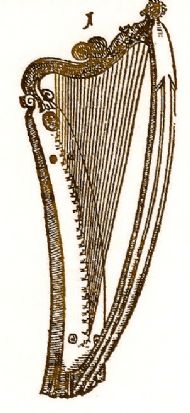
Although it may be a strange sound to us today, this was the familiar sound of the gut-strung harp across Europe for several hundred years, played between the 14th and 18th centuries, and heard in Wales into the early 19th century. They were the classic harps during the Renaissance, and described by Michael Praetorius in his 1619 publication as “the ordinary harp” (illustrated right).
With the wire-strung clarsach being the choice instrument of the Highland Gaels, the gut-strung bray harp appears to have been the harp preferred by the Lowland Scots. Bray harps have long strings, with often narrow spacing, and over time tend to develop a slightly arched back due to tension of the strings. Evidence from the Welsh manuscript of Robert ap Huw points to their use with fingernails; otherwise, classical fingerpad technique is also appropriate. http://www.ardival.com/index.asp?pageid=200766

 Celtic Music Fan