(pictures courtesy of her Myspace site)
Turn off the lights, open your windows. Above the ceiling are glow stars. Outside the crescent moon hangs like a golden boat. The scent of night flowers permeates the air and the stars twinkle above Van Gogh’s indigo sky . A gentle soprano glides accompanied by the majestic harp ,singing about people and places from long ago.
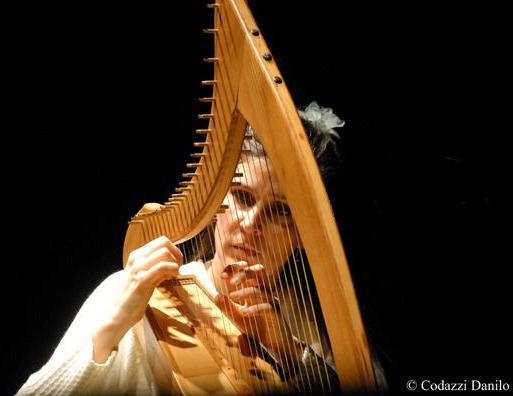
When Cleopatra rode across the Nile river,thousands of years ago; it is believed that she had her barge bathe in perfume and decorated with flowers . People knew then that she was arriving because of the scent. Phil Holland has that same commanding presence with her music .Her harp is the vehicle in which her voice rides on, and her music is atmospheric and beautiful. She could have gone Pop if she wanted to because she is well-versed in what’s happening to the music industry .She also collaborated and performed onstage with a lot artists. She could have pursued playing Classical music and performed in the great venues of the world. But instead, she chose the road less travelled.
This lady has so much to say about music, history and life. When she plays , she evokes the image of a Pre-Raphaelite character or a Madonna. But she is no coy Lady Marian. She is a traveller and an observer. Like an Archeologist, she writes what she stumbled upon through her songs. And they can be love songs…of a different kind. Born in the west coast of Scotland, she is now based in Italy. Over the years she ‘s able to create four albums.
Although she mixes a lot of World ,Jazz and New Age elements in her style, she often resorts to acoustic arrangements.Instead of relying on technology to offer the sonic effect, she’d rather use natural ambiance to carry her sound. This is something totally missing in a lot of current recordings dealing with the genre. I am one of those who got a rare opportunity to Interview this artist and you can tell it has been a fun and rewarding experience.

I like your approach when it comes to the harp and voice. There is too much clutter in music today and hearing such simple arrangement is a breath of fresh air. Do you go into the studio with a specific formula in mind or are you the type that goes in empty-handed and comes out full?
I love purity of sound and I especially love it when music breathes. So often, musicians forget that, as they must breathe, so must the music. I generally go for an acoustic approach when I record. Just simple harp and voice, as it would be in a live performance. Occasionally I will over-record a violin track, or my voice singing a second time in harmony, but I like to keep things simple, both at the recording stage and at the mixing stage.
There is purity and power in your voice. How did you come out with such singing style? Maybe because from a very early age I sang a lot. At home I liked to go with myself on the piano singing folk songs and a lot of classical songs and arias, whatever I could find really. I also sang in an a cappella choir which did a lot of renaissance music. I think I learnt early on how to support my breathing.
The 26-stringed harp as an astounding instrument. Do you always take it anywhere?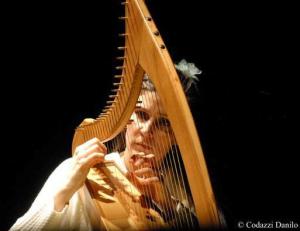
In my earlier recordings I used a lightweight 26-stringed instrument which was light enough to carry anywhere, but it had tuning problems, reacting very badly to temperature and humidity changes, which could be a nightmare in a concert situation. I also needed something with more reach and versatility so I’m now playing a heavier 34-stringed harp. It’s still portable but I do sometimes need a helping hand from some kind-hearted strong-armed knight in shining armour!
The marriage of Greek and Celtic music is a fascinating concept. We know that ancient Celts travelled as far as Italy and Greece. Do you think that your music aims to awaken that collective consciousness buried deep within what we call as long cultural sleep?
Absolutely, yes! I am a firm believer that deep down we are all connected in some way. Years ago, people travelled much more than we imagine, and I think it is entirely possible that there are connections un-dreamed-of between cultures so apparently different. In some Irish folk tales, it is believed that Ireland was first populated by Greeks and Scythians a thousand years before Christ.
I found some curious similarities between Greek and Irish folk lore/mythology, and while it will always remain speculative, it got me thinking. So in my mind really we are all connected all over the world, and music is the one universal language that can bring us together
Other places you are marking down in your map for travel or perhaps musical fusion in future recordings?
I haven’t really got anything marked down. I’ll go where the wind takes me, and if inspiration hits then I’ll know it.
There are a number of mainstream artists today that cater to adult, sophisticated tastes. I think is is amazing especially that generally, it is thought that music buyers are younger people who are into disposable pop music. With this realization, do you think that with good promotion, your music can reach far wider audience than ever imagined?
I certainly would like to think so, who knows? It is strange that the music business not only tends to forget about the great number of people who love music and are curious and sophisticated in their tastes, but also assume that all young children will have the same taste for soulless commercially-produced “products”. It’s all about dumbing down and telling people what they should listen to, the same way the fashion industry tells us what to wear.
Who influenced you musically? And what were the artists you listened to(and still listening to now) whom you think encouraged you to do the music you are doing now?
Over the years so many different and varied artists have inspired me and influenced me that I find it really difficult to pin anything down. I find I can appreciate and be inspired by an artist who is miles away from my own sound. As a teenager I discovered David Bowie. I was blown away by “Offramp” and “As falls Wichita so falls Wichita falls” by Pat Metheny in the mid eighties. I adore Tchaikovsy and Vivaldi and loathe Mahler and Wagner. I listened to hours of Ella Fitzgerald when I was a teenager. I never really sang along to pop songs, except for Kate Bush. I love what Sinead O’Connor is doing getting back to her roots. The list goes on…
I was definitely influenced by the folk song background of my family. I then studied classically and was strongly influenced by all the musicians I met and all the music I played. When I was studying at the Royal Academy of Music in London, I began to feel a negative vibe in the hot house atmosphere and the “preciousness” of the place and that definitely pushed me to try things out on my own. I tried jazz and played with some members of a big band from the 80s London scene called “Loose Tubes”. I got talking to Eddie, the flute player and he took me to the Camden Composer’s Workshop where I experimented some more. I was very aware that my classical training had inhibited my ability to improvise and I wanted to break out of that box. I think at that time I was starting to look for my own voice, the sound I wanted to make. I played with a Mexican Mariachi band, recorded a couple of albums for pop artists, even did a single for a gothic punk group. A long story ensues, but I found myself drawn back to my Celtic roots and when my daughter was born I sang so many songs for her and this pulled me further in that direction. I love writing music. When I’m in a creative mood I stop listening to music completely and I find that silence will inspire me more than anything else. The sound of the sea and the clicking of boat masts and seagulls are all sounds that inspire me, maybe because I grew up by the sea on the west coast of Scotland. Loud, violent sounds upset and disturb me.
You are also doing live performances. How was it like to play side by side with Alan Stivell? I love his music.
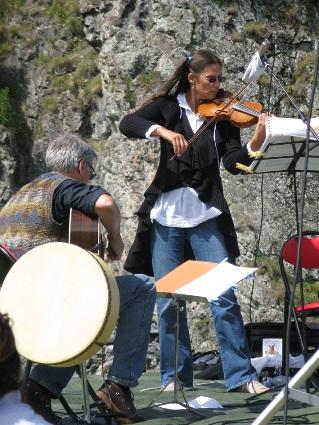
I love performing live. Generally-speaking you feel a real bond with the audience. Alan Stivell is a great and fascinating artist. I played in the same festival as him. There were three harp concerts and mine was the night before his. I was interested to hear how he was experimenting with his sound and form and how he obviously did not feel constrained by genres. It was very liberating and ground-breaking.
Let us talk about Greece and Sappho.I learned that in 2009, you launched and conceived the first Sappho Festival by performing on a rock in which she jumped to her death 2,500 years ago. What was it like?
It was amazing. Sappho jumped to her death from Lefkas rock. For a couple of years I had been thinking how I would like to play where she had stood and feel the presence of this great poetess/musician. I had written a song called Lefkadia Sappho which I also performed that night on the very edge of the rock in front of about 400 people. The only lighting was the full moon and hundreds of candles. It really was a very special atmosphere.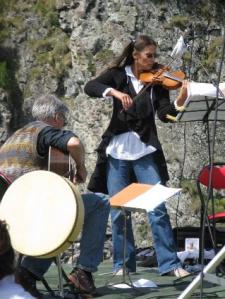
You are a master violin and piano player who studied professionally. Tell us about each instrument as to what comes to your mind .
I actually started, as do many children, with the recorder (descant and tenor). Afterwards I moved on to the piano and the violin. I loved them both equally. They both gave me different things. With the violin I could play in orchestras, quartets and trios as well as playing solo, and with the piano I could play alone and still create harmony, accompany my singing, accompany others. I came to the harp later and it seemed the perfect instrument. The first time I touched it I was in love. Where the violin is passionate but demanding, draining you of energy until you feel exhausted,
the harp is a generous instrument that gives energy and serenity in equal measure.
For you, what does self-development means(musically and personally)?
I want to be myself and be happy being myself. Musically and personally. It’s not conscious but I think my music reflects the serenity that I’m looking for. I don’t like to feel boxed-in. If my music reaches out and touches someone, that makes me happy. After one concert in Italy a young Indian guy came up to me and said in English, “Your music has entered in my heart and now I will carry it with me.” That touched and encouraged me more than he will ever know.
To know more of Phil Holland, please click the links below.
http://www.philholland.net/http://www.myspace.com/philholland2
http://philholland-celticharpandvoice.blogspot.com/
Help this site by sharing this post:




 Celtic Music Fan