Plus: The High Kings and Festival Interceltique de Lorient
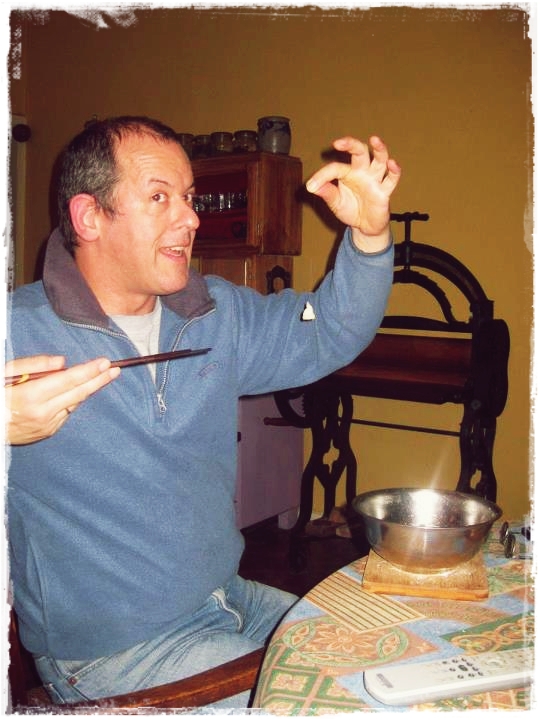
Timothy Des Roches: The invisible noodle(string)
The harp fascinated me since childhood. I owe that to the movies and also the late Japanese jazz harpist Tadao Hayashi (in grade school) who started me in this path. He made me realize that the instrument can create a lot of sound textures depending on the player.
With my journey to the discover of Celtic music, it was not hard to fuse the past and the present. Hearing the instrument gives you deeper meaning when you know its history and its construction. How or why does it make such sound? As what poet Lao Tzu says about traveling..”A journey of a thousand miles must begin with a single step.” And also “For my part, I travel not to go anywhere, but to go. I travel for travel’s sake. The great affair is to move.” –– Robert Louis Stevenson. Learning is a great journey -by knowing the harp more.
You have to realize this didn’t take place in one day. Tim and I just sent messages and ideas back and forth as we went along:
I got a brilliant idea for the interview. Why don’t we make a picture discussion. I will go ahead and post pictures from your picture gallery and let you explain further. We will make it as informal and chatty as possible.
Or if you prefer we will make it on the main conference with Scott(Hoye). Anything that makes you comfortable.
After sometime….
He said: This may be mildly interesting to you. I’ve been discussing the build of a traditional wire strung harp with someone for some time now. This person desires a replica harp with an English Walnut pillar and column (the sound box is to be 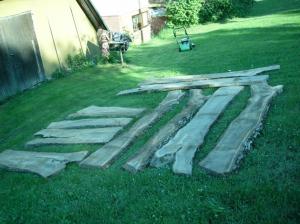 carved from Linden/Lime ,latin: tilia. Our conversations started over a year ago. Well, after about one year I came upon a proper log for the carved sound box (the wood needs to be green/wet), and after countless hours of searching I just found the English walnut in the right thickness (rare) in Southern Poland. Enough for many harps and pleasantly priced – WAAAAY cheaper that it would be from a US vendor, even though the wood is actually more common here than in Europe. It’s very odd to me how these things seem to make themselves available when I’m close to being ready for them even if the odds are stacked against me. Money is always an issue – I have little and wood and transport are costly – and transport is always challenging as I haven’t a car.
In the picture the shorter lengths are about 1.5 meters long and 7 cm thick, the rest is 5cm thick and about 3 meters long. The wood has “seasoned” naturally for five years. Commercial wood is usually kiln dried, which is less desirable for musical instruments.
Now this is a great thread starter  😉
😉
Hey, I know that pic (referring to the picture below).
Let us discuss about wood carving in this picture. How long did it 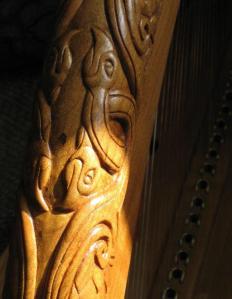 take for you to finish this one?I am actually in your album now.
Hmmmm, 80 hours maybe. But “in the round” like that is a real pain and I never clamped that piece while working on it. Or rather, I clamped it with my left elbow while carving with the right and left hand.
You seem to take harp making a step further by adding intricate designs. How do clients react to your finished products?
The design took longer than the carving – I can take a long time to settle on a design. When it’s for me, as this harp was, I want something I can live with, something that fits the harp. If a carving is for someone else THEY decide; that makes things easier.
What clients? Thus far it’s all for my wife, except one small wire harp. They liked the carving a lot, it made the harp more personal. For myself, I enjoy finding what the wood has within and adjusting to the grain. Thankfully, every piece of wood is different so even if you’re making the same design over and over there’s always something new, but hand carving adds another layer to that.
Interesting!
I didn’t know you have so many” weapons” ( see picture). How did you get into harp building?

I like “les armes blanches!” There’s absolutely no such thing as too many chisels. Grab and air-sickness bag, love got me involved. It was my 5th anniversary that was approaching and I wanted to give Magda something special. The fifth anniversary calls for a wooden gift so I set myself to thinking. I remembered that she had once told me that as a little girl her dream was to play the harp, but in Communist Poland that was beyond the grasp of all but the luckiest of talented youths, so she opted for classical guitar. So, I researched and bought a harp kit from Musicmakers; it was a 26 string Limerick harp in walnut. I did some simple carving to to make it truly hers and found an interest in both harps and carving. Later I made a connection with the harp maker Rick Kemper of Sligo Harps and have been enjoying a kind of intl. apprenticeship with him. Rick’s harps are awesome and he’s been very patient and kind to me. It’s now four summers that I’ve been cluttering his shop with myself and one harp project or another.
That is the best gift I have ever heard in ages!Look at these gorgeous harps she got.These are wire strung harps right? How many of these are in your house now?
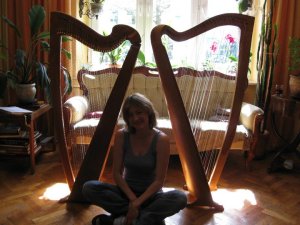
Actually Magda has an irrational preference for nylon or gut strung harps. Those floor harps in the picture are nylon strung (there’s no money in my piggy bank for gut). On the left is the second harp I “built” for her, a Muscimakers Voyageur (another kit) on which she wanted carved dragons. On her right is a cross-strung harp that was the result of my second summer spent in the company of Rick Kemper. So, that’s two, then there’s my little 19 string wire harp (bronze strung) of lime and cherry, a nineteen string wire harp of cherry and maple (strung in brass), the 32 string Lamont strung in bronze and silver, and a small 22 string nylon harp bought before I decided to build a kit harp. That makes 6, and I’m currently working on a triple strung harp (81 strings) for Magda because there’s still room to throw a cat in the music room. Oh, and we live in flat that’s right in the middle of Lodz.
That one is really tiny. I haven’t seen a size like that before.
Small wire-strung, that’s the lime/cherry – fruit flavoured! Except that 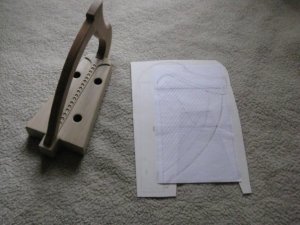 lime/linden trees aren’t fruit bearing and the cherry is a wild and rather unpalatable fruit bearing variety – better for cabinet making than jam making. That is actually the first harp I made all on my own. The wood for the soundbox came from a tree being felled on my way to work.
Let us talk about construction. What are the yes and no of making levers and of the kind of materials you use?
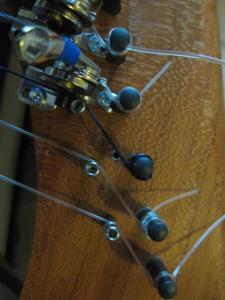
Whoa! I don’t make levers and wouldn’t want to. Levers are made by elves and dwarves in unknown lands (I do fear that some of this activity takes place in China – at least component manufacture, but I may be wrong…I hope I’m wrong. I have installed levers, and shall likely do more of it in the future although it’s not my preferred way to spend time. The levers in the picture are Camac levers and are very popular for their quality of tone and ease of use – by the harpist. Other brands exist: Truitt, Delacour, Peter Brough, Loveland, Robinson… Each type has it’s advantages and disadvantages.
Peter Brough Brilliant bronze semitone levers
Thanks!
Nylon and steel strings…the difference in sound, construction and the challenges making each?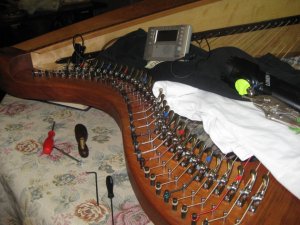
Wow, esoterica. Interestingly enough, nylon and steel strings both call for just about the same vibrating length. Wire harps are strung (usually) with brass or bronze. Brass and bronze call for shorter (significantly so) vibrating lengths for a given note than than nylon. Nylon, gut, nylgut (a synthetic), or fluorocarbon strings all produce a “typical” harp sound with some being darker, some brighter, some punchier… Brass and bronze strings sound closer to a harpsichord when played with great technical skill. The wire strings have a greater sustain and typically less volume from the harp although in some ways the sound carries better. Steel strings sound more like little bells, more tinkly.
Nylon harps are lighter built than wire harps and requiring a greater length of string material for any given note. Given a wire harp and a nylon or gut harp with the same range of notes, the nylon/gut harp will be bigger. Wire harps tend to be styled after existing historic harps or harps depicted in stone carving or period illustrations. There is a greater freedom of form and materials used that can be perceived in the nylon/gut strung harp arena. Many lever harp players cry out for lighter and lighter harps, one builder even builds in carbon fiber – ultralight. You’re more likely to hear wire harp types clamoring for archaic dry joinery (no adhesives) and specific woods. All types of harps have their merits and uses.
For more on string theory, try to get your head around my friend Rick Kemper’s brilliant explanations:
http://www.sligoharps.com/string.html
Tim, if people are looking for great harp manufacturers, where would you refer them?
Who are they? WHERE are they? What kind of music do they want to play?
Generally I’d tend to go with one woman/man operations. You get more of a dialog, more personal service. USUALLY a better instrument. Big name companies are more interested in NOT having to perform warranted repairs and that forcibly affects building strategies and sound. It’s nice to buy local. If not, make sure a competent luthier lives within a couple of hours drive. A floor harp can be expensive to ship for repair work!
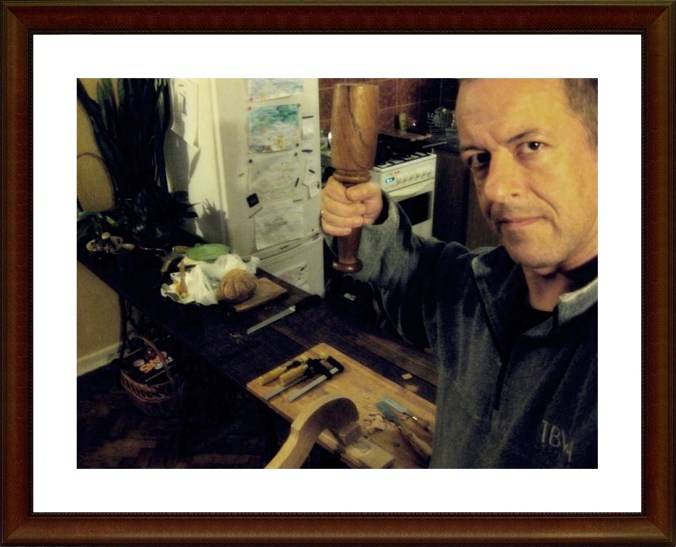
Timothy Des Roches is the guy you might want to look for if you want a harp builder. His bio says:
I live in Lodz (woodge), Poland with my wife, Magda, my son, Mieszko (myeshkoh), and my dog. Life just keeps getting better.
***
Featured video: The High Kings – “The Rising Of The Moon”
Check out the new video “The Rising Of The Moon”, from Ireland’s ‘Best Folk Group of the Year’ THE HIGH KINGS. Their new album “Memory Lane” is out now in the US.
Get your copy at Amazon here – http://amzn.to/h53CHG
My appreciation to Christi for posting this on her network. One of the best Irish groups!
***
Today in Pictures: Festival Interceltique de Lorient Grande Parade 2012

Copyright Michel Renac- FIL2012



 Celtic Music Fan