I am blogging using other people’s computer. Don’t ask me how this happened but I am on the run right now. However I could not pass an opportunity to present this interesting band.
Azarbe are a folk group from Spain that are going to take the cultural music of Spain by storm. The music is nostalgic and caped with pure energy. The musical style borrows heavily from flamenco with traces of Galician flavour. The group was formed in 1999 composed of the following members :
Hi folks, if you want to hear the songs of Linda Welby or songs related to her style then you need to tune in to tune in to http://www.irishcountrymusicradio.com/. Her voice is soothing and beautiful. She sings of songs that come from the heart. When you hear her, it seems like she is singing what you feel. She taps into that humanity in all of us, breaking the barrier between the artist and the listeners. This is the kind of honesty that is hard to reproduce using studio gadgets and production gloss…because this comes from no other place but the heart.
I always tune in to Martin Bridgeman’s shows. He is our special guest and he tells us about his experiences working with the medium for years. Radio has been an integral part of our society and a force that shaped generations and still continues to. What’s very interesting about this piece is that it is actually an insider’s look at the history of radio in Ireland.
Radio Daze
Being a brief(ish) ramble through my radio career from Dublin to Kilkenny
By
Martin Bridgeman
Martin Bridgeman with Brian Cash of Dublin outfit, Halves at the festival hub at Left Bank.
Where to start? To sound like a cliché, I have simply loved music all of my life and heard a lot of it first on radio. I have an early memory of hearing the Beatles in their early prime when I was very young, so we’re talking early 60’s anyway. I would have grown up listening to pop records that my older cousins would have bought and played so many of the big pop and rock acts from then are implanted in my brain.
I entered my teens – where I believe your musical soul is forged – in the 1970’s, the era of Rock giants like Led Zeppelin, and the emerging glam stars like David Bowie and Marc Bolan, electronic pioneers like Tangerine Dream, Eno and Kraftwerk and the edgier folk players like John Martyn. I admired Paul McCartney’s early DIY phase, John Lennon’s searing honesty. Although Punk kind of passed me by (I didn’t share the anger) I can see how it shook up the prevailing trends and pared things back to the essentials of rock and roll. Through these artists I came to appreciate the roots of rock and roll, the early starters, the players, the singers, the legends that have now been appreciated for the trails that they blazed for the artists since to travel. I’m happy to say that our children have always been open to new music and have respect for what has passed before, which is all I can hope for in anyone starting out in music. Listen, then decide!
I found US bands like Talking Heads intriguing and love how they have all taken many musical journeys as artists and still keep us enthralled. Blondie straddled pop and new wave and Patti Smith followed her own artist’s path and instincts and continues to do so. Joni Mitchell, Kate Bush and Leonard Cohen were always in the background, never disappointing and proving how important an artistic manifesto is the key to making great, timeless music. All the time, Irish bands were making their presence felt, some more than others, to a point where we have an enormous wealth of talent relative to the size of our country (in my opinion).
Since then I hope I’ve been ever open to new music and my list of favourites continues to grow (as does the physical space in our home has to accommodate more and more music, books, magazines and mementoes). I’ve been blessed to have had many broadcasters, fellow musicians and a small number of true friends to lead me metaphorically by the hand, opening my horizons musically and continue to do so.
Radio
Until the later part of the 1970s Ireland had just one radio station. In a spirit of punk, and following from the popular movement 1960’s in England, pirate radio flourished across Ireland and, despite constant government harassment, made sufficient impact and held public appeal that it helped to create a new national music station playing music people wanted to hear. (Incidentally, it was an Irishman that helped set up Radio Caroline – Ronan O’Rahilly). That’s not to be overly critical though: the (single) national station had a public service, news, current affairs and broad arts remit so it was never going to be able to satisfy all tastes and was national in tone.
What the pirates did was to provide truly local broadcasting, offering new voices an opportunity to play their passions on the airwaves. Many bands had their first outings on legendary pirate radio stations such as Radio Dublin, ARD and Sunshine, the three main stations that took on the mainstream and won handsomely. Many rightfully esteemed national broadcasters in radio started out there…a thriving local radio network is still playing what people want locally.
Radio and Me – Part 1
My neighbour was the legendary DJ Pat James who started his broadcasting life on Radio Dublin. He gave me my first break on radio in 1978 and I still remember pushing in the heavy doors in Inchicore, Dublin every Friday to play my wilfully broad range of music, cycling back home late/early filled with all the energy I needed to get up for work the following morning and with a head full of ideas for next Friday. Thankfully Pat is back on the air in a unique slot on a Dublin-based Classic Rock Radio station called Nova (itself a name harking back to the golden age of pirate radio). His rocker soul is still very much intact
I was left the freedom to play what fired me and I never took notice of genres, regularly playing Steely Dan and the Bothy Band on the same night. I still do, now admittedly over two nights.
The Wilderness Years?
I spent most of the 1980’s playing music for fun (never for profit anyway), cover bands such as Calling Card, original bands such as Geoffrey’s First Affair , La Bata and the Sad Anoraks making me open to even more styles of music.
Radio and Me – Part 2
Time passed as it does, like a thief, stealing the years and finding me relocated from Dublin to Kilkenny, where love and family have kept me since 1993. I found myself hankering back to my Radio Dublin days as a new local station came into being in Carlow and Kilkenny, KCLR96FM. I approached the management and they seemed to think (a) I wasn’t completely delusional and (b) I was worth a try. Circumstances and luck combine in life and my particular combination in 2007 led me to the music shows I present there at present. Together, they speak to my interpretation of the word ‘eclectic’ I hope anyway.
The Eclectic Light Programme
The Eclectic Light Programme is a place where you can’t anticipate what styles of music will appear. That is deliberate and often left to chance. I feature a lot of what is new in Irish and International music without looking over my shoulder to see what other people think.
I have met some many talented people it gives me great hope for the future. There is a serious amount of talented young people in Carlow and Kilkenny and I’m happy to offer them a place to come in and share their passion about the music they make.
And in case you’re wondering about the title…It has multiple layers of pun-infested meaning.
“The”: I believe that many great bands have that as the first part of their namers, who am I to judge?
“Eclectic”: No style turned away.
“Light Programme”: Back when I was growing up, my radio hummed into life and displayed these exotic locations, including the BBC Light Programme.
So there it is, my Saturday night dip into the waters of what is good non-mainstream music. With puns in.
Essentially you could argue that the name means a taste of Irish, but in truth our folk traditions are so closely interlinked that you will regularly hear Scottish, English and Breton music too.
Being from Ireland you can take so many things about our traditional music and song for granted but I would have listened to the legendary Seán Ó’Riada and the Chieftains in the 60’s while listening to Irish rock bands such as Thin Lizzy and Horslips and great artists like Van Morrison and Rory Gallagher whose own take on the blues and R&B was washed through with sometimes subtle Celtic melody and phrasing. As for rock bands, I would have been brought back to the traditional players that had passed by largely unknown by comparison with the popularity enjoyed by today’s players; fiddlers like Michael Coleman, pipers like Séamus Ennis and singers like Joe Heaney and Margaret Barry were all revealed to me by the musicians of the 60’s and 70s, the Dubliners, Planxty and most by the group most important to me, the Bothy Band.
The explosion of recording in Ireland in the 70’s provided some of the most timeless Irish music, artists such as Mick Hanly, Andy Irvine and Paul Brady creating classic albums, as did the Chieftains as they moved out of Ireland, paving the way for a new generation of players and singers. What appealed to me as a listener and gig goer initially was the openness of the new generation of traditional players, breathing new life while respecting its roots. Each week brings me yet more evidence of how a living and breathing tradition is safe in the hands of those who play Irish music.
I also believe that your own experience must shine through and inform, your music which is why I would hold that the Pogues are as representative of their upbringing as the children of emigrants as are those who emigrated from Ireland. Theirs was a fiery brew of passion and sadness, (lazily caricatured as drink-fuelled) but passionate through and through. Dublin native Damien Dempsey is a young man filled with passion and shot through with the balladeer’s soul, while may fine musicians mine the rich heart of Irish music to create something new, respectful and heartfelt, Mícheál Ó’Súilleabhán and Iarla Ó’Lionáird being just two.
My musical travels take me to England, Scotland, Wales and Brittany as well as over and back to the United States where Irish music moulded itself in to folk and bluegrass. We share common stories, hopes fears and history, but joined together by the people’s music in all its forms. Englishman Chris Wood and Scotswoman Karine Polwart are two examples of singers with a fine sense of the political tradition and a willingness to move it on and are regularly played on the show. Every year the Kilkenny Arts Festival brings more musicians to us, bring a new perspective, country or tradition.
If there’s a defined shape to the programme, the first hour is largely instrumental music and lively, the second more reflective and quiet.
Again, I’m heartened by the amount of talented traditional musicians and singers, fiddler Rebecca McCarthy-Kent being one, Kilkenny pipers Mick Foley and John Tuohy keeping the flame burning and recent resident Nell Ní Chróinín bringing her wealth of traditional sean-nós singing to us.
So here I am , Saturday night on “The Eclectic Light Programme” and Sunday night on “Blas Glas”. Not so much a job as a joy…
Micheal Curran talks about Cavan Fleadh, playing traditional Irish music and the over all joy of gigging!
A stereotype would have been created around the old fleadhs and festivals, suggesting that it was only old people who used to go to them, and that there was very little to do but play music. But modern festivals have evolved and now include events for people of all ages and interests.
Today’s interview is unique. Not only that it highlights the musical culture of the Irish youth but it also gives us the in depth observation of what happens to music festivals from someone who has been playing in these events for years. Between college dissertations, teaching at workshops, Celtic Connections -wow talk about being busy, Michael was able to work with me in these questions. His responses are veryinformative and he is a fine writer himself.
1. How does it feel to share the space with other talented musicians in the field of traditional Irish music?
Playing Irish music has totally shaped more or less everything I do; it is like a religion, a way of life. I suppose if you were to ask the same question to any young ‘trad head’ like myself, they would give you the exact same response. I feel that playing music has developed me personally and nurtured me into the lad I am today, but if you were to ask any of my non-musical friends they would just say I am absolutely crazy, and they are probably right! Music has been a great outlet for me ever since I started playing when I was around 10 years of age; it is a fantastic pastime, hobby or whatever you would like to call it.
But apart from all of that, I think the most rewarding part of playing Irish Music with others is the friendships that I have built up over the years. Playing music has opened many doors and introduced me to so many wonderful people; having created countless friendships that last a lifetime. Music has given me loads of brilliant opportunities to travel all over Ireland and further afield, bringing my box and my music wherever I go.
In a way the space shared with other talented musicians is quite a small knit one, like a little community all with the same shared passion and interest. Music can break barriers for people and is like a language, many people from different nationalities from all over the world can play together as one. With thanks to modern technology, the internet and in particular social networks, the small knit community of Irish trad can develop on a global scale; we can stay in regular contact with musical friends all around the world, and music online is available at our fingertips. It is without a doubt, an interesting and enjoyable scene to be part of.
2. You aren’t part of a band yet and you aren’t working on an album right now. But what do you have in mind this year?
Even though I am not working on an album right now, it is something that I have not ruled out, and I would hope that in the not too distant future I will get the opportunity to put some tracks down to record. I personally feel that I am not ready to record just yet, within the last few years I feel my style of box playing has changed and developed into a more distinctive and personal style, but then again I feel it can develop even more in the next few years, so there is always room for improvement!!
When it comes to recording, I think patience is very important. Money and financial gain should not be a motivator and one should take the time to play and record music they are happy with. Time and time again I have heard other musicians who have recorded albums say that on hindsight they would have did things differently, such as not rush into recording, do more research and gather more knowledge. I will not rush into a recording studio just yet, I will when I feel the time is right, but most importantly, when I feel my music is right.
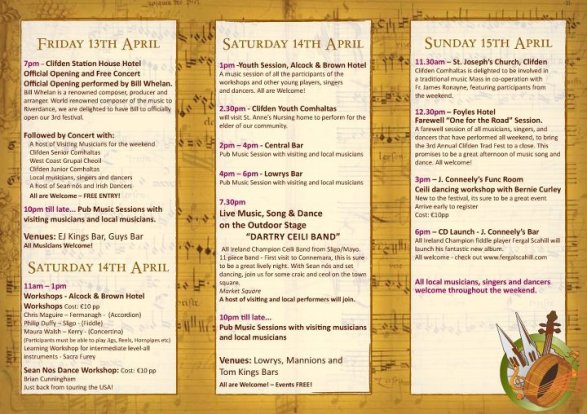
I am currently in my final year of civil engineering in Queen’s University, Belfast, so recording has not even entered the equation at the moment. Because of a hectic and intense study schedule, I find I do not have as much time to play as I would like, but fortunately at the weekends I teach at home in my spare time and go to local concerts and sessions when they are on. Also in the coming months before the Fleadh season kicks off in the summer, I have been asked to play and take workshops at various different festivals throughout the country, including the James Morrison Festival in Riverstown, Co. Sligo, and the Trad in the West Festival in Clifden, Co. Galway to name but a few.
3. Tell us about your big involvement with the Cavan Fleadh, and if possible give us an in depth look at the scene and the things that happen during these gatherings.
Being from the North, and only a short forty minute drive from Cavan Town, I have been very fortunate to meet and befriend many great people from that area within the last ten years. One such person is the widely known Martin Donohoe, virtuoso button accordion player, and a big influence on my own playing. I remember going to his house with my father when I was around 14 for a one off lesson, and I suppose it was a turning point for me, in the sense that he opened my eyes to the big bad world of trad, as it made me recognise the huge scene that is out there and one that I could get involved in.
Currently Cavan have hosted the last two All-Ireland Fleadhs and we will be back there for the third year in a row for Fleadh Cheoil na hÉireann 2012. The Fleadh is one of the biggest music festivals in Ireland, and one of the biggest Irish Music festivals in the world. Basically the Fleadh is a week long plethora of music, song and dance, with concerts, workshops and numerous impromptu sessions happening on a regular basis. Thousands of people descend onto the Fleadh’s chosen venue every year to meet old friends, make new ones and just generally have a good time.
Although probably for a lot of musicians and seasoned listeners of music, the Fleadh is about the competitions. Every year a new All Ireland Champion in different age groups are crowned, depending on their instrument. To compete at the All-Ireland, one must firstly gain qualification through their local County Fleadh, and then do likewise at their Provincial Fleadh, before they perform on the big stage. In August 2011 in Cavan, I was fortunate to gain 2nd place in the Senior Button Accordion competition. It was a great achievement which I was delighted with, and I suppose that is where my involvement lies!
4. You were in the Glasgow Comhaltas two weekends ago. Now you are back in Scotland. What are your schedules?
Yes, before Christmas I was asked over to teach the box at the Glasgow CCÉ Winter School of Irish Music, along with some other musicians and friends from around the country. The organisers always have the workshops in January as it coincides with the world famous Celtic Connections festival, Scotland’s premier music festival, spanning a period of three weeks. I had just finished some of my college exams days before I was due to fly out so I thought the weekend would be a nice break. The workshops took place on the first weekend of the festival, and we were given the opportunity to attend some of the major concerts and also to the famous ‘festival club’, which had a range of different genres playing until the wee hours, accompanied by a late bar…music and beer, ‘What more can a man ask for?!!’. This was my first time at the festival; I loved the atmosphere and enjoyed it that much that when I got back home to Ireland late on the Sunday night, I immediately booked flights back to Glasgow for the finale weekend….a decision I did not regret!
I have no set schedule when it comes to playing music. I have a simple motto, ‘If I can go, I will go’. There are always sessions and concerts on regularly around my area and I like to try and get to as many as I can, although as I mentioned earlier there are a few festivals and workshops that I have been attending for the past few years, so there are always set around the same time annually.
5. You mentioned about Civil Engineering as your course. I noticed that most Irish musicians have double careers, one that is musical and then otherwise. It seems like music doesn’t have to get in the way of your other career path as the case of most musicians I read about. Is this a common thing over there?
Yes I suppose it does seem quite common in a sense. However I feel that being a student has massive advantages. If you look at some of the savage up and coming young bands on the scene at the minute, Éalu, Goitse, JPTrio to name but a few, most of those guys are around my own age and are still studying, in particular music related courses. A lot of these bands were formed through music projects; maybe they got the opportunity to record and put a show/tour on the road as part of an assignment, and of course the main luxury for students is the extensive time off, meaning that they can afford the time to partake in such events.
As for the well known bands and musicians who have been on the road for years and who hold down a full time professional career away from the music, they probably have managed to establish a system that works both ways, so they have the times/tour dates etc set months in advance to accommodate their full time jobs.
I know from my own personal experiences that time management is very important when planning to play music and studying/working. For me I try to treat playing music as a hobby but there are times I have found myself travelling and gigging quite extensively and it sometimes feels like a job in itself! I try to find the right balance between the two so the enjoyment always remains. There have been times when I have had to miss out on some gigs and turn down invitations due my studies, but I suppose that cannot be helped. On the plus side any time I am away on a long weekend playing, I do not have a boss to answer to on a Monday morning if a few lectures are missed!!!
6. What do you think are the things responsible these days in bringing people to get into these musical events?
There is no doubt that Irish Music has had something of a revamp over the last 15-20 years. It is cool for young people to play music nowadays, and with so many festivals, fleadhs and other regular gigs on they are spoilt for choice. Modern technology has also played a huge part in this change. Long before televisions and computers tunes would have been swapped with older musicians at house parties and ceilis, passed on from one generation to the other. Nowadays all a young learner has to do is go onto websites such as YouTube and TheSession.org in order to get tunes, as well as online tutorials and tune books etc.
A stereotype would have been created around the old fleadhs and festivals, suggesting that it was only old people who used to go to them, and that there was very little to do but play music. But modern festivals have evolved and now include events for people of all ages and interests.
Personally I have always enjoyed going to these events to meet new people, as well as the many old friends that were made in previous years. The swapping of stories, playing of new tunes and just the general craic element is hard to beat. The people who go to these festivals are kindred spirits; they have the same interest as I do for the music and craic, and that is what I think are some of the things responsible for getting people involved.
7. What actually happens behind the scenes at these festivals? And what are your preparations whenever you are attending these events? How do you get along with other musicians and also deal with curious Celtic music enthusiasts?
As I mentioned earlier, the main emphasis at a Fleadh would be the competitions. Held over a weekend, they normally take during the day on a Saturday and Sunday in specific venues and locations chosen by the organisers. In the evening time sessions would take place in the local pubs of the town including local and visiting musicians, as well as some of the competitors who want to relax and join in. Some fleadhs also run concerts, dancing or singing sessions as well.
Festivals I feel are more relaxed particularly as there is no competition element to worry about. Most of the festivals I have been to have to have similar structure, again taking place over a weekend period. Usually there is an opening concert on the Friday night, with local and visiting musicians, and afterwards everyone descends on the pubs in the town for music sessions. On the Saturday afternoon workshops take place with all the different instruments, giving young musicians a great opportunity to learn from master players in a close proximity. The Saturday night and Sunday afternoon usually concludes with more sessions, which give all the local and visiting musicians to swap tunes and have fun in a relaxed atmosphere. If I am playing at a concert or taking a workshop I usually like to prepare by having a set list of tunes made out prior to the performance, and also have recordings and photocopies of music notes ready for the workshops.
It is very easy to deal with other musicians and enthusiasts as we all have the same shared interest, and possess the same affection for the music and song. The love of the music is what brings the people together; you will hardly ever meet a ‘bad’ person in the Irish Music scene. For those interested in the music, my advice would be to go and experience it first hand; head to a fleadh or festival and soak up the atmosphere, listen, play, make friends and most importantly have fun!!!
For Michael’s next scedules, refer to the post below:
Fans of Celtic music will find something to enjoy in the following facebook links that I am posting below. We aren’t small anymore. There are events and venues being set up all over the world especially in the United States, Canada and Europe. All we need to do is to be resourceful in finding these networks and be a member. I also discover new artists from them.
Pan Celtic Festival-Cornish artist Matthew Clarke made me join this group and it is all about the love for Celtic fusion. There are 217 members comprising of musicians and fans of the music. https://www.facebook.com/groups/110876723848/
The Celtic Link-A very informative site dedicated to musicians, bloggers and fans of Celtic music. If you want to know what’s new , then this is the place to hangout. https://www.facebook.com/groups/thecelticlink/
Aberfest-An even that celebrates the musical relationship between Cornwall and Brittany.April is the month of events. You don’t want to be late! https://www.facebook.com/groups/8079694323/
East London Comhaltas-This is a network dedicated to any Celtic music related activities in the east of London. Musicians who jam with other musicians post here often. You will know about latest gigs in this are in London. https://www.facebook.com/groups/8079694323/
Celtic Music Fan’s Weblog-A facebook page I created. Please join and share your thoughts. This is all about music and the good stuff about it. I currently appointed 4 administrators including my friend Christi who comments here often. https://www.facebook.com/pages/Celticmusicfans-Weblog/105906649451348





 Celtic Music Fan