The orange cover artwork shows the silhouette of a bare tree with birds on its branches. One should be aware that experience and wisdom can bring about something excellent. I had the pleasure listening to Fine Friends by Sliotar. A band interview is coming out soon.
The few chords of the opening track remind you that Sliotar can pack a wallop. Stick the Kettle On is an instrumental tune with captivating grooves. The uilleann pipes of Ray MacCormac remind you that pipes replace electric guitars here. A quarter to two minutes of this song will send you pogo dancing with gusto.
All Too Real showcases the band’s songwriting style that has that adult alternative twist. Even JP Kallo’s singing style fits the format. For those who like their Irish music more contemporary and radio friendly this is a fine example.
All Around Lough Gillis another instrumental tune showcasing the tin whistle. The drumming of Des Gorevan maintains its crunch all throughout the album without being too over powering. It took me several listens to this track alone to note that we are dealing with complicated drum styles here. Listening to music is like detective work. You don’t see pieces of evidence unless you look further and really pay attention.
May Morning Dew is sung without accompaniment. The strong sometimes gruff vocals maintain that expressiveness. The lyrics and the reverb created by either the room size or mixing have that compelling combination.
One Chance is a personal favorite. I like the sunny melody here. JP sings ‘Another Monday morning, coffee keeps you going, running late for work’ I think the Sliotar should expand on this direction more. I hear keyboards. I hear that nice editing effect applied to the last part of the chorus. Whoever did the sound engineering here has done an excellent job. I give this a high- five!
Rays Heel catches you by surprise with its unpredictable arrangement. It begins with that stately tempo, which calls to mind an idle walk , then around 2:50, it explodes into that fast jig that again gets you on your feet.
I could not stop smiling to Rock-A-Bye Baby. It has that ingratiating appeal in its simplicity and intimacy, stripped of the drums. A perfect song to listen to when you are depressed and you want comfort. ‘Rock-a-bye baby..rain falls from the autumn sky..another wind blows hard and cold..let me keep you warm’ …Catchy!
Tinkering on the Bridge begins with the uilleann pipes and builds up into that foot tapping jig. It changes tempo at 2:05. The energy of this track really makes you rock your body.
Take it As it Is follows the vibe of track 7 but with the drums. This is one hell of a tear jerker.
Whiskey in the Sauna makes me imagine that I am catching butterflies with my fingers or doing a kung fu/ Arabic dance steps on a Saturday night after meeting kindred spirits. Have you tried drinking whiskey in the sauna?
The album closes with the solo vocal track Fine Friends. It reminds you that after the laughter, everyone must part ways.
The album Fine Friends, also tells us that after listening to all the tracks, you will surely come back for more.This album deserves more listens because like good friends, the songs provide company that are enriching in all aspects.
About Sliotar
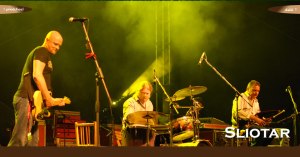
Sliotar is a three piece band based in Dublin playing modern folk music.
The roots of the tunes they play come from the music of Ireland,
but in the past few years the group is relying more and more on original
compositions. Sliotars fourth album, Cirque de Sliotar, has finally captured
the modern sound that has been in development and has been an obvious
at their live shows. Sliotar has been around now over twelve years,
eight with the current line up, and they have one of the longest running
residencies in Dublin in the Porterhouse. Also in the past few years
Sliotar have changed their way of touring, resulting the band travelling
all around Europe and even further. And still the Sliotars best asset is
the live show. Around 200 concerts every year keeps the band tight and
the energy of their live show is something that can only be experienced
and is not for the faint hearted.
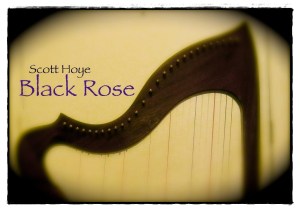
Black Rose: An album of moods, textures and layers.
I am listening to Black Rose, a Cláirseach harp and vocal album by the American Celtic musician Scott Hoye. It has all the satisfying elements that you can find in a traditional album. Yet it has the experimental quality of a New Age or Ambient album. There is a good balance between instrumental and vocal tracks here. We find songs that are familiar, including Eleanor Plunkett. His track by track arrangement is eclectic. I hear strains of Liszt in Ultima Thule while other tracks like Oh Rainy Night just oozes with folk/rock vocal harmonies. Black Rose is an album filled with elegance and emotional beauty. And his influences are very refreshing.
Eleanor Plunkett is played the way I remember Clannad did it in the 70s. It has that same down to earth appeal yet with elegance in its simplicity. It is tied up to Fanny Poer which has percussion and whistle. The ambiance is live. This is exactly the kind of sound you hear on live acoustic performances.
Scott used to be part of a rock band the Seranati. Think of Jethro Tull and Traffic. This is evident in his powerful voice that has the crunch of an electric guitar with its remarkable range. But he is being subtle here as he incorporates the Irish Sean Nos style of singing .The Flower of Magherally is rendered in a capella. I heard several versions. One is by Altan and the other is by Anuna. I have to confess Scott’s singing stops you in your tracks.
The South Wind takes us into another instrumental journey. This time we hear the delicate playing as his fingers move from one string to another with an experienced grace. The notes off the harp twinkle like little crystals. Then the tune moves into the poignant melody of Carricfergus. Here the whistle has never been so bitter-sweet. I love how these two instruments complement each other with such subtle ardor.
Black Rose which is the title track is another a capella tune. Again we hear Scott’s strong but expressive voice where he dips from woeful highs to smoldering lows. Partly Gregorian, partly rock, his singing is really magnificent.
A Neansai Mhile Gra begins and ends with the kind of delivery that is expressive and simply beautiful. This track is very visual. This is the same kind of element you can find in his Celtic band The Spriggans.
Oh Rainy Night takes us into a rock twist with its engaging vocal harmonies. This is the style where he shines. Scott isn’t really for tamed emotions when it comes to singing. Like a wolf that needs the wild, his voice is a force of nature, so stormy yet beautiful with its power.
Where Time Stops is gentle as of a balladeer telling a story. “ I can show you a place where the time stops”..he sings with such ease of expression that when he moves to the chorus with layered voices it becomes epic. I’d call for more rainy afternoons with this song. Like a walk in the fields when the downpour stops, watching the leaves glisten. This is the kind of beautiful imagery this song brings to mind.
Sad Nika brings back that Sean Nos air that track 2 and 4 have. With varying arrangements, Scott has created an album of moods, textures and layers without having to call for a lot of collaborations.
The last track Ultima Thule is a long piece with an almost operatic quality. It is dreamy, hypnotic and it is the kind of music you would like to hear when you are waiting for the rain to stop. I think without this track Black Rose would sound incomplete. Everything about Black Rose simply go together like forks, knives and spoons. Dinner has been served. And yes it is a rewarding listening experience.
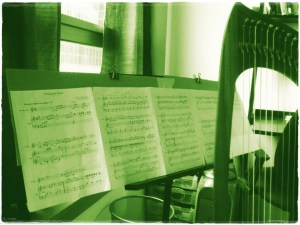
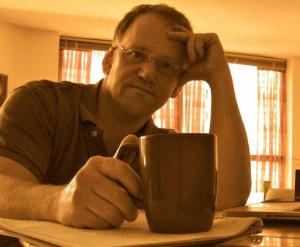
The composer at work.
Blurb about Black Rose from liner notes:
Black Rose has been many years in making. Several of the tracks were written long ago for two other projects, Seranati, a progressive rock group, and The Spriggans, a Celtic ensemble. Both groups performed and recorded in the 1990s in the Detroitarea. These songs did not see the light of day then, and they have simmered on the back burner of my mind over the years. I have re-imagined them for this, my first solo recording. Black Rose has slowly taken shape, like a musical journey with many vistas along the way. It is a fusion of many of the things that impassion me: traditional Celtic, pop, folk, and ambient musical styles.
Black Rose, the tune, was written for a friend when she had hit upon some sad times. I had initially imagined it as a prelude to a tune called Beauty’s Daughters (a.k.a., Lord Byron’s Stanza’s for Music II) crafted by my self and guitarist Patrick Penta, and played by both The Spriggans and Seranati. The refrain was written without my knowledge of the term Black Rose being attributed to Ireland; a sort of code word for the longing for a independent country during the British rule. This was a happy accident, and I humbly offer it up as a new, Sean Nos, or “old style,” a cappella song, like those popular in traditional Irish music. Two other songs here fall in this category: The Flower of Magherally (a traditional Irish tune) and Sad Nika. My friend, singer-songwrite John Hammink, wrote Sad Nika after a hiking trip in Europe. He wrote it for me to sing while I was a member of The Spriggans. I am exceedingly happy to be making it available here now. Thanks so much for waiting, John. Hope you aren’t disappointed with the effort.
Oh Rainy Wind and A Place Where Time Stops were both written for Seranati. Oh Rainy Wind describes my life walking to and from bars with various women, or just walking into and out of pubs on long nights. It was written at the behest of the keyboardist, Stefan Economou. Stefan desperately wanted to sing more bright, pop, rather that dark, blues influenced tunes. Here is your “Beatles” tune, Stefan, re-figured as a three-part, a capella, drinking song.
I like to think A Place Where Time Stops was influenced by Sufi and Hindustani religious, devotional poetry and spiritual traditions. I was also between girlfriends when I wrote it, so I can’t deny the process of sublimation in its inception. Singing in a rock band did have some fringe benefits, I suppose.
Ultima Thule is an improvised theme with multi-tracked harp and whistle. My friend Bryan Moore, sculptor and director of HP Lovecraft film and fandom fame, inspired it, naming his new home after the term. “Ultima Thule” is an idea from the ancient Greeks—the most distant, northerly island, geographically, from their perspective. Perhaps Hibernia? Albion? Who knows? By the time the Romantics referenced it in poetry and lieder, when the world had been fairly well mapped, it was an imaginary country; a land of the dream realms. I thought the pentatonic setting would give it an ancient flavor, as well as lending itself to improvisation.
Eleanor Plunkett/Fanny Poer: two tunes attributed to the 17th century, Irish harper, Turlough O’Carolan. These were both written as slantes, or tributes to two of his patrons. I attempted to give a more “archaic” sound to the arrangement with the inclusion of the descending arpeggios. The second tune includes whistle and djembe, an African hand drum, rounding it out with a full ensemble quality.
The South Wind/Carrickfergus: The first tune is attributed to O’Carolan, but sounds more like a simple folk tune to me, so he may have just grafted his own poetry to an older tune, or it was never really a part of his repertoire. Carrickfergus is a permutation of the Scottish tune, “The Water is Wide.” Dominic Behan, Brendan Behan’s brother, first recorded it, and attributed it to, of all folks, Peter O’Toole who learned in, of all places, a pub; fine couple of folks for a harper to be vicariously connected to.
A Neansaí Mhíle Grá: is a simple instrumental version of this Gaelic love song for the harp.
Thanks to the following for their support and inspiration: Ma & Da and clan Hoye; Dick Anderson of Woodsong Musical Instruments for creating a superior harp that has held up all these years; Eric & Cynthia Cathcart, Rachel Hair, Steve Toth, & Chris Caswell for recording tips, and encouragement; all Spriggans great and small (you know who you are); wirestrungharp.com, my Soundcloud cronies and FB harp associates; John Hammink for writing such a great tune and waiting so long; Regina Harris-Baiocchi for kind words and perspective; Delhi street food vendors, just because you deserve recognition, and Atul Mohan for pointing me in their direction, and providing encouragement for this project; the worldwide Khanna tribe (cheers!), and, especially, my wife Shabnam.
No two wire-strung harpists/players are the same. This is obvious in the kind of style that Jochen Vogel has been developing for years. Like guitars, violins and other instruments, the Clarsach is a very expressive instrument owing its grace not only to the player but the way it was constructed. The wood, the conditions that it has been exposed to becomes the result. Then you add the temperament of the player and the kind of musical background he or she comes from. What you get is a refreshing sound that is not like any of those that play the same instrument.
His music is jazzy and ‘modern’ that proves this ancient instrument can find a new place in mainstream audience as well as those that are passionate about the musical culture that it originated from. His rendition of Cancro Cru flows like waterfalls while Fields of Gold along with his cool singing (reminiscent of Chis deBurgh) will send generations of Starbucks crowd playing this as piped in music. Jochen Vogel has mapped his domain ahead of the others and created a kind of music that listeners will chill to for generations.
I have been writing about the harp community lately and I think this link will help everyone who is interested in the history as well as evolution of the Clarsach. Thanks to harpist Scott Hoye for bringing this to my attention.
The beauty of two worlds. No other effect is achieved like the purity of two distinct instruments merging together creating symmetrical patters of sounds…If there is an imagery I can take to describe the beauty of Sophie and Fiacra’s music, then it has to be the Celtic knot work. Elegance, confidence and free spirited warmth are all reflected in the four sample tracks you can hear in their audio and video gallery.
The two came from musical backgrounds. Sophie Lavoie, is from Quebec and she was introduced to music from a very young age. From piano, she moved to the violin incorporating both Classical and folk influences of her region. Fiachra O‘Regan, from Connemara, on the West Coast of Ireland, released his own solo album and has been known in festival circuits playing and teaching pipe music.
These two musicians have something fresh to offer in the Celtic music scene. Not only that they play beautifully, but they also take their website image seriously. You can buy their albums here: http://sophieandfiachra.com/shop
Since the start in 2008, Sophie & Fiachra have gone from strength to strength with performances in Canada and throughout Europe, and TV appearances on RTÉ and TG4 in Ireland, and Borio Channel in Germany.Sophie & Fiachra have just recently recorded their debut eponymous album (buy). Their concept is fresh and original; music from Sophie’s native Quebec blended with that from Fiachra’s home, Ireland. The result is pure powerful music.
Both band members are very much devoted and true to their traditions in terms of music, and each have been influenced by listening to recordings of Masters from previous generations as well as Current Masters. They share many tunes as their music shares its origins. The styles of these two musicians blends naturally and without compromise; their music is vibrant, rhythmic, and timeless. This Is Old Quebec meeting with Old Ireland.
Because of the Styles of these individual musicians and the nature of their instruments, the music ofSophie & Fiachra sounds like much more than a two piece band. This energetic music promises to entertain and astonish all Audiences.
Just saw this video post that my friend Jimmy posted today. I think this video took home a message of hope. Brian’s Bodhran Beater’s is getting a lot of attention from the media. His passion for creating this Irish instrument turned his life around. And he has never been to Ireland yet. Well maybe this time he will. It looks like his bodhran business is doing well.
Wonderful things happen where the heart is. I am sure someone out there is thinking the same thing. We are all connected in ways we can’t imagine. And nothing is as powerful as the bridges created by music. Our Celtic music.
Passion is such a beautiful thing isn’t it? It takes you to places. It can be a bitter-sweet thing. It can take high or it can drop you down. But most of all it makes you feel. More about this man here : https://www.youtube.com/user/BriansBeaters


 Celtic Music Fan