Also in this edition: Gaitafolia and Featured performance:Gillian Boucher (fiddle), Seph Peters(banjo), Anna Ludlow(fiddle) and Mary Beth Carty(guitar)
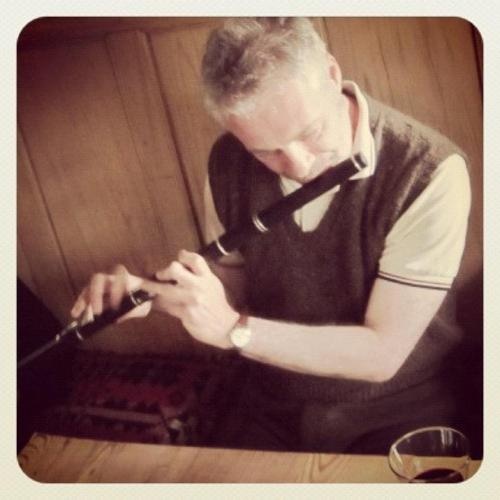
Ceri Rhys Matthews taken with Instagram
Ceri Rhys Matthews talks about what it means to be a musician bridging tradition and innovation to the fore.
The prose of Ceri Rhys Matthews flows like music. He answers questions as honestly as he can. There is a wealth of wisdom in his opinions and he does them with the ease of someone who has conversed and played music with people of varied cultural backgrounds.
My meeting with him started after hearing the music of fernhill. I was also doing research about the top pipers of Wales and his name not only came up frequently, I also got recommendations from his peers.
I am sure you will enjoy reading this informative conversation the way I enjoyed formulating my questions and reading his answers.
You are very well known in the Welsh trad scene. How did you master the art of piping (and also the wooden flute) and who/what really influenced you to take up piping?
A long time ago, I moved back to Wales from studying Art in Maidstone, Kent, in the east of England. This was in 1981, when I was 20 years old. There was a sound in my head that I wanted to hear but I didn’t know what it was. One night a friend said, “Are you coming to the session tonight? There’s a man coming who plays pibgorn”. And I knew instantly that that was the sound I could hear in my head, even though until then I’d never even seen a pibgorn, nor knew what that instrument was. I played mandolin at the time.
Later that summer I was playing some tunes on my mandolin, with a cittern player in a session in pub in Pontardawe, and the pibgorn player came and sat about a yard from us staring and listening intently. “Where do you get your tunes from?”, he asked, and I told him. “Hmm”, he says “Owain Alaw, check out Owain Alaw”. I already knew that repertoire I told him, and we got talking. I asked him if he’s make me a pibgorn, and so he did. Jonathan Shorland is his name and he’d been making and playing the instrument in Aberystwyth for a couple of years before we met. Anyway, we struck up a friendship and I’d visit him at his workshop and play tunes at his house and at sessions. I watched how he played, and listened and copied. He played flute too, and that’s when the flute began to seduce me.
Some years later I was more in love with the flute than the pipes, and so
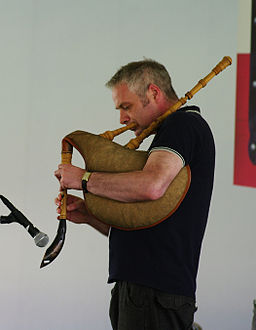
Ceri Rhys Matthews playing a Welsh Bag-Hornpipe or Pibe Cyrn
tentatively moved over to that instrument more.
What I play on both instruments is driven by two disparate things. The first is the desire to copy things that I hear and like. I’m pretty bad at this. I pick up all the wrong habits, and I’m very, very slow at learning other people’s tunes. The second is a desire to realise sounds that I hear distantly in my head. Then there is the process of focusing these nebulous sounds to make them more concrete and memorable – but still retaining a freedom each time they’re played. These two thing correspond roughly to what people would term traditional in the first instance, and creative in the second. But I see them as pretty close activities.
What can we expect from fernhill this year?
We have now enough new songs and tunes to make a new album. But money is very tight and we can’t afford to record another album in the foreseeable future. We are gigging, and playing the songs to people, and this is very important to us; to keep the flow of the music moving, and so I guess that some of these pieces won’t get recorded, as new songs take their place in our performances. Songs seem to have their time, and then move on. Sometimes, parts of old songs will find their place in new combinations, so it’s not altogether a bad thing that some don’t get recorded. But we like recording too, and so maybe next summer or autumn we’ll have another think.
I consider Yscolan as one of the best trad albums. It really represents Welsh music. When will you do a follow up to this kind of style?
Thank you. Again, I think the answer to this is pretty much like the last question. I could make many such recordings, but playing live to people seems to have taken over, and this is not such a bad thing. I have learned so much, and continue to learn from playing music to people. If an offer came from someone to make a follow up recording, I could do it next week, but I don’t expect an offer, and so I get on with playing. The playing changes and flows because of this, which pleases me.
Apart from your gigs with fernhill are there other collaborations you do?
Out of the solo work, and the fernhill work, has grown my work with Christine

Photo by Christopher Levy
Cooper, who plays fiddle for fernhill. (She’s also a storyteller in her own right).
I am coming to think that duet playing is the pinnacle of what I am working towards in my music, and Christine is helping make this more apparent to me. It helps that she is such a talented and also an understanding musician. Her musicianship is subtler than mine, and enables a very workable collaboration. In it, I tend to be a starting point; and idea or melody, and Christine helps embody or realise the idea or vision.
When two melody lines play almost in unison, something more concrete manifests to the listener, and the players. They create a triangle, but a fluid moving narrative of three points. A solo performer can create a hierarchy between himself and the audience, which is not always bad but is something I’m less interested in. The relationship between two independent but related performers, on the one hand, and the listeners on the other seems to me to be a sort of artistic democracy that is central to folk music, and that gives it wings to fly. The players can respond to each other and the listener, who in turn can influence what is being played.
Christine and I have begun to develop this recently in a thing I call “Rambles through Tunes”, which is described pretty well by Kate Pawsey here:
http://yscolan.tumblr.com/new_work
and here:
http://www.folkradio.co.uk/2012/10/ceri-rhys-matthews-rambles-through-tunes/
It’s not a new idea, of course. Or my idea. But an idea that has gripped me.
What is the state of the Welsh trad scene right now in your opinion?
It’s a complicated question. One could begin by asking, like the historian Gwyn Alf Williams asked, “When was Wales?”, and by extension, “What is Wales?”
I see the tradition(s) and the creative urge here in this place as part of a continuum of musical activity throughout these islands and beyond – to the continent, and further afield still. Much of what I have learned personally as a musician, for example, has been abroad. Surely the experience of musicians throughout the ages. I learned about the guitar in Uganda, in Africa, even though I started to play in Swansea. I learned about the pipes in the Atlas Mountains, and the mountains of Sa Pa in northern Vietnam. I learned about how you make music long instead of short from Hungarian musicians in Pontardawe (the same time as I met Jonathan Shorland).
So I feel uncomfortable when music is defined by geography, let alone nationhood. But so as not to duck the question, I feel that at the moment the music is being politicised to serve a national identity, which will ultimately strangle the music. This is not the first place this has happened in, and not the worst, and it won’t be the last. If I have a role, it’s to make sure that space and freedom are found for individuals and small groups of people to continue their personal musical narrative, and simultaneously for them to be able to breath creatively within their society, and consequently to contribute their music back.
But it’s handy to have a name for the place, otherwise people end up somewhere else if they come and visit! And so it’s possible to say that where I live has many many exciting and interesting things happening musically and culturally.
Fernhill live at Theatre Moliere, Brussels, January 2010. Fi Wela, “I See”
Julie Murphy – voice
Ceri Rhys Matthews – guitar
Christine Cooper – fiddle
Tomos Williams – trumpet
Ceri Owen-Jones on the harp and the well-known Ceri Matthews on the Welsh pipes.
Additional sources:
***
Featured video:Portuguese bagpipers Gaitafolia- Passeado Valsado
These musicians are amazing!
***
Featured performance:Gillian Boucher (fiddle), Seph Peters(banjo),Anna Ludlow(fiddle) and Mary Beth Carty(guitar)
Intense performance! More here: http://www.thecelticumbrella.com/

 Celtic Music Fan