Transatlantic Sessions – S03E04Oganaich Uir A Rinn M’fhagail ‘Spinning Song’ (O Noble Youth Who Has Left Me) Julie Fowlis with Donal Lunny & Bruce Molsky
Today’s feature takes us to the enchanting music of Julie Fowlis. Julie is a native of Uist in the Hebrides and she grew up listening to traditional tunes. She is also blessed with a beautiful voice plus the talent with different instruments especially the pipes.
What made Julie appealing to me is her way of adding shine to the old tunes. If you look at her interviews, you can tell that this woman is possessed not only with a great sense of humor but a sense of mission as well. She does it so passionately that at such an early age she is already regarded as one of the stalwarts in the business.
This woman smiles so easily but when she plays or sings there is that rapt concentration that is so intense it is almost like laser. Her repertoire is composed of lively as well as laid back traditional songs but never loosing that perky sense. Julie’s music is for those who love the beauty of spare arrangements but dynamic tempos that hearing her sing in a fast Puirt a Buil makes you think of butterfly wings fluttering from flower to flower.
Julie will always make me think about the beauty of Scotland and the Hebrides which will make a nice tourist destination if you want to recreate the sense of wonder that her singing brings to our hearts.
***
Useful Links…
Life sciences spin-out Celtic Catalysts wins innovation award
Locklin Road, a group performing Celtic and folk music, will present the Coon Rapids Arts Commission’s third concert in its annual dessert and coffeewinter concert series.
Theology Degrees Online is an attempt to provide prospective students with a single online resource for understanding the numerous different options that face students who are considering a degree in theology. This website strives to be an objective and unbiased witness to the educational landscape and help students avoid some of the less obvious pitfalls therein.
Website Creator
Tim Dalton D.Th. has worked in academia as well as published biblical scholarship for over 10 years. As an individual concerned with ensuring the quality of future religious leaders and scholars learning, Tim created Theology Degrees Online.
Contact Us
If you are interested in contributing to Theology Degrees Online, please contact Tim at info +at+ theologydegreesonline +dot+ com. All comments, questions, and suggestions are welcome.
***
The Epistle of Paul to the Galatians, often shortened to Galatians in the Holy Bible is one of the best references to the Celtshttp://en.wikipedia.org/wiki/Epistle_to_the_Galatians. This is the center of Michael Card’s album Starkindler: A Celtic Conversation Across Time. I love the amount of energy and arrangement placed in this album and I rank this (along with Moya Brennan’s Perfect Time) as the best example of Contemporary Celtic Christian Music.
***
Rich evocative tune that can only come from the North West of France is played by a group called K.V. (“Paotr ar maraise”). Sorry if the info is written in French-I had to copy this off their myspace : http://www.myspace.com/kvgroupe
– Bombarde : Ivonig LE MESTRE
– Uilleann-pipes / Binioù : Lionel LE PAGE
– Piano : Kevin HAAS
Brythonic is a Southern group of Celtic languages. Plural is Brythonics. Examples are Breton, Cornish and Welsh.
From Wikipedia: may refer to: British language, or Brythonic, the Celtic language anciently spoken in Great Britain | Brythonic languages, a branch of the Celtic languages descended from British | Britons (historical), the Celtic people of Great Britain in ancient times. Too bad the Brits were the ones who tried to get rid of any Celtic influence in the region in the latter part of history.
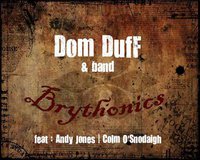
In the spirit of the language and culture, Breton artist Dom Duff is staging a concert:
Dom Duff (Breizh) : Kan, gitar,
Andy Jones (Swansea) : Kan, Gitar, Cittern
Colm O’Snodaigh (Dublin) : Kan, Flute, percussions
+
Claude Ziegler : guitares électriques, mandoline
Dom Bott : bass
Mourad Aït Abdelmalek : batterie, percussions
Kanaouennoù savet tro dro ar Brythonics
Brythonics stories and songs
Brezhoneg / Kembraeg / Gouezheleg / Saozneg
Breton / Cornish / Welsh / gaelic / english
I owe this great link to my friend Loic Rathscheck whom you might remember in my earlier interview. He’s a Frenchman so there flows the Celtic blood in his veins. He doesn’t play Celtic music , rather his style is electronic but he shares my passion for almost all types of music. He is a memorable contact because he is the first person I attempted to interview. Anyway, this important link he sent to me is Andrew Lenz’s Bagpipe Tips: Learning Bagpipes without an Instructor. I think the winner in this article is not just his answers but the way he delivered them-with honesty, candour and humor.
“Anyone learning an instrument on their own can be their own worst enemy, with bad posture, poor fingering techniques, bad tuning, etc.”
What exactly does it take to learn the bagpipes on your own? This article lets you know the ins and outs of self-instruction, offers some advice and suggests some resources to help you.
Is it possible to teach yourself bagpipes?
Yes—to a point—but it is a road fraught with peril, unfortunately.
What’s going for you.
The bagpipe chanter—the bagpipe part with which you play notes with your fingers—only sounds one note at a time, so there are no chords to worry about. There are only 9 possible notes to sound (not counting a few special somewhat rarely played notes). This means that reading bagpipe music is relatively easy. And learning the basic fingering is simple.
What’s going against you and why you should get an instructor.
You’re going to get a lot of commentary in this section!
I have to say that the idea of a person teaching themselves bagpiping sets off warning bells in my head as it does most pipers. While sometimes it is a necessity due to a very remote location or poverty, in others it’s a case of people thinking that somehow the bagpipes are a “teach yourself” kind of instrument.
It’s not.
If you are even half-way serious about learning the pipes, I strongly recommend that you find yourself an instructor.
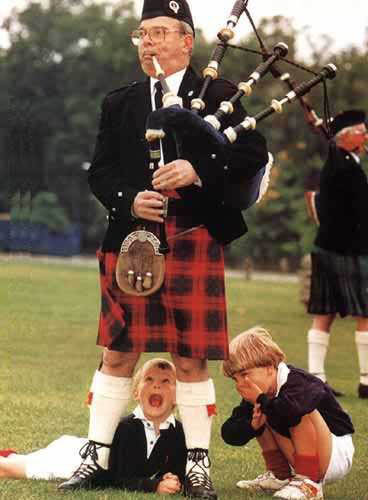
The bagpipes come with about as much in the way of instructions as a piano comes with instructions on tuning it, or a guitar on how to play chords. Next to uilleann pipes, the Great Highland Bagpipes are the most complex wind instrument on the planet—four reeds!—this is a real instrument requiring real lessons. Bagpipes are exceedingly easy to play incredibly poorly and can be quite temperamental at an inexperienced hand. Maintenance is complex compared to most instruments. Tuning the instrument proves be quite a challenge to most new pipers—heck, even many experienced ones! That’s one of the reasons the pipes get such little respect sometimes. Too many people try to teach themselves bagpipes, fail, and now here we are with a slice of the general public with a strong dislike for the pipes, oblivious to the fact that they were exposed to very poor piping.
The following may sound harsh. If you want to just doodle with them, in my opinion, you should avoid playing public as you will be representing all the truly dedicated bagpipers that have gone before you, world-class and otherwise. Friends and family fine—tell them you are a beginner—but not the general public. If you think you’re getting good enough to play in public, play in front of an experienced piper or better yet, compete at a highland games to get a truly objective appraisal of your piping skills.
There are no world level pipers that I ‘m aware of who were self-taught. Not that competing at that level is your goal necessarily, but it goes to prove a point. I’ve heard of one Grade I piper (the highest amateur grade) who was self-taught—David Daye, a link to his site is below—so it’s possible to do well on your own if you have a disciplined perfectionist personality with a very good ear for picking out minute sound problems and figuring out how to correct them…it’s very rare.
Anyone learning an instrument on their own can be their own worst enemy, with bad posture, poor fingering techniques, bad tuning, etc. If you are self-taught, try as you might, there’s a good chance you won’t know any better. You might get used to playing a chanter that’s out of tune and think nothing of it. Having an instructor set up the tuning on your practice chanter as well as your bagpipe chanter will have you developing a sense for a true bagpiping scale while you are practicing.
Another thing is self-taught pipers tend to be impatient, as are probably most learners, so without an instructor to hold you back from techniques that you are not ready for, you may press ahead anyway. For example, you could try to learn complex embellishments (series of notes) without even having basic grace notes down correctly. It’s much harder to unlearn a technique then relearn it correctly than to simply learn correctly the first time. To quote one formerly self-taught piper: “Like others, I found what I was doing was a misinterpretation of what I thought I was seeing and hearing.”
If you decide to learn piobaireachd—prounced “pee-brock” and is called the “classical music of the pipes”—you’ll discover that relatively huge departures are taken from existing sheet music. As an example, you may find three notes to be shown to be played even, when in fact the last should be played 2-3 times the length of the others. Granted, you can pick up a lot of this timing from recordings, but an instructor can help you pull every last bit of expression out a tune. This also applies to “light music” (marches, jigs, reels, etc.) though those are played much closer to the printed page. Commenting on his early unsuccessful competition experiences, PM Jim Harrington had this to say: “The problem was simply not knowing how to express the music—but that’s a problem with just about every tune when you’re a beginner with no instructor.”
Having had a bagpipes teacher for years, I can testify to their value. I’m not alone in having an instructor tell me that a bad habit has snuck in, such as my wrists are in the wrong position or an embellishment has a subtle fingering error. Even with an instructor showing you in-person how to do something, you can often go home and practice an embellishment incorrectly. It may sound right to your untrained ear, but at least it’ll be caught and corrected by your instructor as soon as your next lesson.
“No matter how many times you say it… No matter how much you may try to drill it into folks’ heads… A person learning on their own is not going to realize they need an instructor, until after they find an instructor… A slurred D-Throw sounds perfectly fine to someone who has never had it played slowly and correctly for him.”
Andrew MacTao, after 18 months of learning, having starting on his own.
These’s a saying that goes “Seven generations and seven years to make a piper.” Your instructor will be your link to those past seven generations. The seven years is up to you.
“I already play a wind instrument, I don’t think I really need an instructor.”
I’m going to let someone’s quote answer this one.
“I was classically trained in both trumpet and clarinet in college. Learning bagpipes has been a dream of mine since I was little, and there’s no instrument comparable to pipes in a technical or musical sense. If you want to learn bagpipes at a high level, you need high quality instruction from someone who has learned from a high quality teacher. If I used my classical training on bagpipe music, none of the gracenotes, or even the beats, would be in the right place. Even bagpipe tuning is radically different. I could go on for pages about the differences, but I can’t do anything right without my instructor. Each time I think I understand a new piece, nope, it’s different than I thought.” B. Hunter, band director in Houston, Texas.
“I can’t afford an instructor.”
Trust me, you can’t afford to not have an instructor. Some bands even give instruction for free. But even if you can’t find lessons at no charge, you are talking about an investment in your future. There are numerous cases where a self-taught “piper” cannot discard bad habits and learn the proper way to play and a frustrated instructor simply gives up on that individual. Often not the case, but it does happen. Get as much personalized instruction as you can afford as early in your piping career as you can manage.
“I don’t live near an instructor.”
Gregg Heath of Belgrade, Montana had this to say after a year and a half of learning: “I realized early on that self teaching was a non-starter. I did it long enough to pick up some bad habits that my instructor is gently helping me correct. I now travel 200 miles round trip once a week for instruction and band practice and it’s well worth it. If you want to play the pipes bad enough you’ll find away to get to an instructor.”
Gregg isn’t that unsual. I’ve heard of numerous students driving over three to four hours to get personal interaction with an instructor, it was so desired. Some cities have several piping teachers. Some counties have none. Maybe not “fair” but that’s the way life is.
“The nearest instructor is really far away!”
Assuming that you’ve looked correctly and there truly isn’t a piper around to instruct you face-to-face, then consider any personalized instruction very valuable. There are ways around not having an instructor within a reasonable distance. And you don’t have to meet with an instructor in-person to get individualized attention.
A tried and true method of remote but individualized instruction is sending audio cassette tapes of your playing to a teacher who then records comments and lessons for your playing. Improvements in technology has lead to newer methods such as swapping video tapes, e-mailing sound files, interactive Internet video conferencing. Another method is to simply use the telephone to engage in a live two-way lesson. One of the first websites attempting to capitalize on the need for remote instruction is LivePiper.com. What’s important is to get feedback specific to you so that you can concentrate your practice on your weaknesses.
Other opportunities for instruction are various piping seminars, workshops, summer schools, and the like which may be within your means to attend.
“I’m moving near a teacher soon, what can I do to get a head start?”
Probably the best thing to do is to simply wait and spend your free time listening to lots of bagpiping recordings. This will help develop your ear.
But if you know who your teacher is going to be, then ask him/her as to what practice chanter he/she prefers and with his/her permission, puchase that brand—but be careful, he/she may want you working on nothing! (Or if you have a practice chanter already, ask if him/her if it will suffice.)
If you don’t know your instructor, purchase a good quality practice chanter made in an industrialized nation (Scotland, USA, Canada, etc.). Buy a rank beginner’s tutorial book—check with your bagpipe supply shop. Learn the basic finger positions then learn to read bagpipe music and correlate the two. (Avoid learning combinations of notes, i.e. embellishments.) Avoid playing tunes, but if you can’t control yourself, please ignore the gracenotes for the time being. Playing tunes can introduce the possibility of changing notes incorrectly resulting in “crossing noises”—most common are in changes from a lower hand note to a higher hand note or vice versa—which an instructor will then have to go back and spend time correcting!
Remember: the more you push ahead wihout a teacher, the more risk that you’ll learn something that you’ll have to undo later.
Things to do to accelerate your learning
Listen to a lot of professional solo bagpipe recordings. Get as many CDs as you can get your hands on and listen closely and critically.
Go to highland games and piping performances/competitions. Given the choice, listen to the more advanced pipers. Though it may be inspirational to hear lower grade pipers competing also—”I can do that!”
For bagpipe maintenance and tuning, Jim McGillivray’s “Pipes Ready” and “Pipes Up”
videos and for detailed excersizes for embellishments, there’s his “Rhythmic Fingerwork“: http://www.piping.on.ca
Pipe Major Bill Robertson’s Bagpipe Tutorials (Light music and piobaireachd): www.bagpipe-tutorials.com
***
Here’s another link to a video he sent me. Wow! Red Hot Chilli Pipers having a Scottish time at The Ferry in Glasgow
***
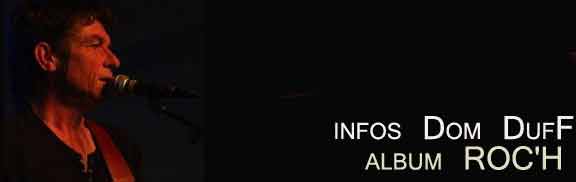
I voted for Dom Duff’sRoc’h in the Grand Prix du Disque . Dom is an amazing musician from Brittany who continues to bring the Celtic Breton tradition to the fore by collaborating with only the best musicians and writing primarily in Breton. I wish he wins because I think Roc’h is an album of eloquent achievement. You can also vote for him through this link:
Giving you the joyful gift of this beautiful song by Wolf Tones. Look at all these nations bonded together by a common culture.
***
Calum Stewart, tullochgorum & varations…
I love the way he breathes life into the wood instrument. Calum has been recording with Welsh bandMabonand has proven that he is one of the ambassadors of Celtic music to the world.
The hardest working artist in Ireland is finally getting his due….
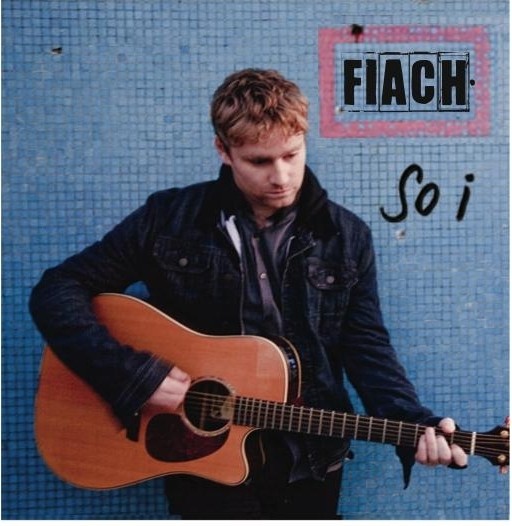
Some of you might ask who Fiach Moriarty is. But for those who are acquainted to the Dublin music scene, Fiach has been known as the hardest working artist in Ireland. He has been in a lot of TV shows and live performances. Also one thing to note is that last year he came first in the annual Celtic Language Contest in Inverness Scotland. So how’s that for a 27-year -old used to be under- the- radar singer? The Irish Times calls his album So I a debut album of depth and courage, guile and wit. I stumbled upon him the first time in YouTube and that’s it. His charisma is undeniably powerful and there is so much positivity in his songs that you can’t help but be uplifted.
This is an interesting performance of a song sang in Gaelic, a love song called Sea Taim at minority language song contest Liet International 2009. Sea Taim is about a young lad who is down and out – and drunk – after his girlfriend left him.
YAOUANK 2010: Here’s a video featuring my pal Dom Duff from Brittany!
***
Sacred Art
Courtney Davis inspires Celtic Spirituality
Have you visited his website lately? I think there’s a lot of things there for everyone. I just love the wonderful pieces he created. I have been a fan of Celtic art for years and when I stumble upon something as beautiful as this I like to tweet it out.
I got this from the media release . Those into Breton music will be pleased with what’s coming up.
Hi all,
Here the news for this autumn:
– We are playing Milan Capodanno Celtico fri 29th Oct. (full line up)
– Interceltic Lorient festival asked me to represent Brittany with my song “Kan an Awen” in LIET Competition (Europeans minorities languages acts, including Asturia, Ireland, Feroes, Sami, …)
– We are working hard for a Brythonics show on 25th february to be launch in CC Amzer Nevez PLOEMEUR (Brittany). The show will be a saga about Brythonics invading Brittany from 5 to 8th century.
A concept in collaboration with Andy Jones (Swansea based singer-songwritter) and Colm O’snodaigh (Kila member, singing, flute, percussions). Songs in breton, welsh, english, …
– Album ROC’H is doing well in shops and is now available in iTunes, Amazon, 7digital, Napster, We7, Spotify, Deezer, …
This brand new opus is in a complete Dom unique Power-Folk style.
As usual, Dom is delivering the same energy, great voice, great guitars, fiddle, banjo, mandolin, bass, drums …
You can listen full songs here : http://www.domduff.com/discography.html
“Good stuff”WSLR 95FM Floride USA “International bewichtment”Planet FM – Auckland NZ “la musique et le rythme sont génials, ainsi que cette jolie voix”Radio Internationale Athènes “Songs with soul” Radio Varna Bulgarie
about ROC’H :
Dom DufF : voice, acoustic and electric guitars, mandolin, e-bow, banjo Nicola Hayes : fiddle Dom Bott : bass Mourad Ait Abdelmalek : drums David Seité : bodhran, cajon, Huw Rees : drums Patrick Péron : piano

 . What’s important is to get feedback specific to you so that you can concentrate your practice on your weaknesses.


 Celtic Music Fan