Legends of the Celtic Harp

North American fans are in for a musical treat this July. Four shows are scheduled for Legends of the Celtic Harp. According to Lisa Lynn Franco:

Four California shows with Patrick Ball, Aryeh Frankfurter and myself performing “Legends of the Celtic Harp” a musical tribute to the true stories and folklore of the harp through time. It is a wonderful show and Patrick is his usual self…Which is brilliant! It’s funny and moving and touches the heart.

Santa Cruz on July 5, Santa Barbara on July 6, Pasadena on July 7 and Fresno on July 8. Write me for details or visit www.LegendsOfTheCelticHarp.com

Music for a Peaceful Heart , the albumhas been out since May 1. She is one of those musicians who introduced the atmospheric beauty and grace of the Celtic harp. The Circle of Joy is still my favorite instrumental track of all time.

http://www.lisalynne.com/

Scott Hoye Talks about His Home Recording of Black Rose (Interview)

Between O’Carolan and Indie music  is a gem of many facets: The home recording of Black Rose by American singer/harpist Scott Hoye.

Scott Hoye is my guest for this week. His album Black Rose is out in the market. It was also the start of my comprehensive journey into the world of harp music. It was an interesting learning experience. There are many harpists around the world. The harp community is growing. Within the community is a wide range of eclectic music. Every artist has his or her own unique approach in terms of style and  arrangement.

Scott Hoye embraces the two worlds of Celtic rock and New Age music. His time with Seranati and The Spriggans contributed to the edgy style of his compositions. On the other hand, his inclination for ambient or meditative music contributes to the spiritual nature of his tracks. It is the kind of balance that is both surprising and essential. This eclecticism enables him to morph into genres. It is no surprise his answers in this interview are well thought of and very informative.

At last your debut album Black Rose is finally out. This is your first solo project outside The Spriggans and Seranati. How do you feel about having this harp album finally?

My experience in creating and releasing Black Rose is twofold. I am extremely proud and happy with the end product, but as the only producer of this album, I can still hear all of the minute aspects of it that I could work, re-work, and work some more to “perfection”. However, you have to tell yourself at some point, “it’s time to kick the eagle out of the nest so that it can fly, live a life of its own”, so to speak.

The experience of recording itself was extremely rewarding, with a lot of learning curves for me. I had to put together a home studio, purchase gear, learn about engineering and mixing, write, arrange, perform all of the instrumentation and vocals, and research mastering, marketing, and distribution. I wore a lot of hats.

My goal was to work creatively, within a limited budget. The technology has changed so much since I recorded with Seranati or The Spriggans. One can literally make decent recordings at home, and work with an engineer for mastering. My goal was to work with as little as possible. Black Rose was created with one microphone, for example. I learned to use that one microphone to get a rich, mellow sound from my harp. It was also recorded in a very dry environment to control for extemporaneous sounds. That required me picking the brains of other people to work with creating a nice, resonant sound during mixing. But, I am probably digressing a bit here, and obviously this shows how excited I am about the process of creating with studio equipment, back to answering your question.

Knowing that songs I wrote fifteen years ago are realized in some fashion feels great. Knowing that I can record and produce music for people to enjoy is also gratifying. I don’t look at Black Rose as a harp album. It does feature the harp, but I set out to make a good album, not a good harp album. I hope that the variety of sounds (vocals, harp, whistles, and percussion) translates into that good experience for the audience.

Here is a link to an article I wrote last year on my recording process: http://www.wirestrungharp.com/revival/home_recording_harp.html

This is brilliant! Home recording is really the trend these days

Thanks! Glad you like it.

That article about Home Recording With a Harp is great to read. I think it is a great source of information for those wanting to start their own home recording. That essay tackles the challenges in terms of the instrumental aspect of home recording. Tell us about the vocal aspect. Your album is rich with vocal experimentation. Oh Rainy Night is an example of what you did with layers. What were the challenges doing that song as well as your approach in terms of the singing style?

Oh Rainy Night was a difficult song for me to re-conceptualize. I had originally written it for Seranati. I imagined it would be sort of like a Beatles song, either ala Revolution, or something off of Rubber Soul. Or, we would at least try not to do it so heavy handed, ala Robin Trower or Black Sabbath. This was the biggest stumbling block for me, as I couldn’t get a stop chorus of guitar, drums and keyboards out of my head. It came down to just laying the lead vocals down, and going from there. I re-imagined it with a harp accompaniment and percussion. Well, the key I liked the vocals in was C sharp major, a very lousy key for the harp to play in; lovely for keyboards. So I wound up say, “to heck with it”. I didn’t want throw out the tune entirely, and decided that a cappella was probably the strongest bet for the tune to work. I think that was probably the best choice.

As for the recording aspects of that song, it was simply adjusting the gain to meet the right level for my very loud singing, and recording the other parts. I wrote the alto and bass section in vivo; while I went along.

I like the mash up between Eleanor Plunkett and Fanny Poer. The result was really refreshing. It could have been a pairing of other songs but why these two?  

Simply put, O’Carolan wrote some of the loveliest harp music. A lot of tunes are attributed to him, and since they were passed down via the oral tradition among harpers, we don’t know which tunes are really his. These two tunes, in my estimation, are elegant, and appear to be a hybrid of Irish music and the baroque music of the English (Anglo-Irish) courts that he was fond of emulating, so I’m pretty sure they are his. The reason I chose to record them is because they are simply beautiful.

I chose to pair them up because they complement each other. Eleanor Plunkett is sad and plaintive. It ends on the dominant degree of the scale, having a strange sense of, or lack of resolution for the listener. Fanny Poer is festive, and it lands right on the tonic. In essence, the sounds move from sad/reflective to festive/happy. Limiting Eleanor Plunkett to solo harp adds to the sense of inner reflection; adding whistle and djembe to Fanny Poer built up the tension and the added color for the arrangement, allowing me to add and remove instruments as the first and second sections played out. I think that using the djembe rather than the bodhran provided a different take on the tune. When paired with the whistle, there is, I think, an almost a Caribbean flavor. The break from the harp at that also provides variety.

Mind you, I didn’t think of arranging these two tunes outright. Rather, I approached them one step at a time, and thought about how the arrangement could be crafted for the most possible interest and variety for the listener.

There is this huge wealth of music within the harp community. I also noticed the support you give to each other as musicians. Do you think that the harp (most specifically the Clarsach) has already attained the same level of mass exposure like say the fiddle or bodhran or do you think it is still heading that way and you as well as other artists are smack in the middle of that turning point?

Good question. I don’t believe the clarsach has attained the same level of exposure as fiddle, bodhran, or guitar for that matter. I think that the reason is twofold. The other instruments are spread wider at this point in other styles of music and just more culturally accepted; “monkey see, monkey do”. I think the other reason is portability. Hauling a harp takes dedication, endurance, and planning. You can easily toss a violin in a case and go. 😛

I do think that the harp is on the edge of really taking off as a more main stream instrument. Lots of great players are doing incredibly innovative work: Jochen Vogel, Rachel Hair, and Catrin McKay to name a few. Apparently, the Scottish scene is booming right now, and lots of young harpers are taking up the instrument. I hope that the wire strung harp comes up alongside the gut and nylon strung as well. I know there are great players on wire who are exposing more people to its voice. It really has a distinct sound, and it, along with the pipes, span the bridge back to the origin of a lot of British isle Celtic music. I hope this second wave of the “Renaissance of the Celtic Harp” includes equal growth for the wire strung.

A Place Where Time Stops is a track that somehow reminds me of   Flight of Dragons. I think it is the flute and the mellow singing. You also mentioned that this track has been influenced by religious and devotional poetry. It must have been an interesting period in your life. Please tell us more about it.
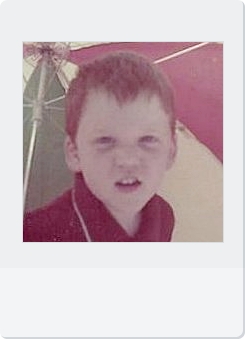
Future Bard

Well, it was an interesting time. I was working quite a bit as a musician and working day jobs in an unrelated field, selling books, and access to a great deal of reading material. I have always been interested in world religions and various takes on spirituality. I’m a member of the Anthroposophical Society, not very active these days, and not very orthodox for that matter. I find that spirituality is a pretty big part of who I am on some level, but I do have a more practical side as well, and try to balance the two out.

The theme in A Place Where Time Stops is based on the idea of the Beloved singing to the soul, so to speak. I suppose the Sufis sing to the Beloved as the spirit or God, attempting to work them into ecstasy. Some Hindu devotional hymns or chants are of Krishna singing to Radha, God wooing the soul. I suppose that the dialog in this tune works more from that angle. The ambiguity of the lyrics allows for the song, I hope, to translate as a simple, tender ballad or, if you take into account the sort of grandiose statements like, “I found an ocean, and you found a stream”, it can be seen as something more. At least I hope that is what comes across.

The first verses and chorus were written in 1995. I flushed the song out a bit more as I re-worked it for the album.

By the way, I just checked out Don McLean’s tune. I’ve never heard it before. Charming! I do believe that it was probably influenced in some way by Gentle Giant, or other prog rock bands that used recorders or winds in their work. All in all, I think it was a song that just fell together well as I was flushing out the parts during the recording process.
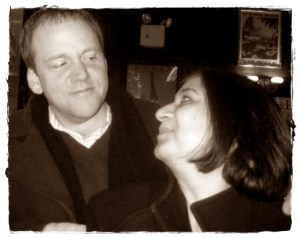
With wife Shabnam

Do you have any plan of releasing Black Rose through physical media?  

Yes. I plan to roll out a physical CD in the fall. I hope to have it available for purchase both directly from me and through an on-line distributor.

***

You can download this track for free. Please support our independent artists by buying the album or re-posting this article in other social media.

http://www.scotthoye.com/

http://soundcloud.com/scott-hoye

http://www.reverbnation.com/scotthoye

https://www.facebook.com/scott.hoye

https://www.facebook.com/groups/celticharp/

Chicago based harper and musician Scott Hoye was a founding member of the Celtic ensemble The Spriggans, as well as the progressive rock band Seranati. His repertoire includes traditional and original tunes on Celtic harp, vocals, whistles, and percussion. Scott gathers inspiration from traditional sources of Irish, Scottish, other Celtic, and folk, and world music, while mixing them together with contemporary sounds to create a new, sonic brew.

Chris Caswell: Harp Builder, Multi-Instrumentalist and Music Teacher.

This is the right way to play the Celtic harp….

Occasionally, we are blessed with someone who has an eye for beauty and a  hand for musical expression. Chris Caswell embodies the nature of a true bard. Apart from being a versatile musician (playing flute, penny-whistle, harp, bodhran, and bagpipes), he is also the builder of Caswell harps. He started making harps in 1972 while also serving as a session player for other bands. His designs are unique and breathtaking- like his own music. He is also a music teacher around the San Francisco Bay area.

I got the time to sit down and really listen to his tunes this evening. He gives multiple expressions to the harp in a way that it sounds like different instruments. At times it reaches sublime spirituality especially when he does those arpeggios. There is something ‘quiet’ about his music that speaks to you. One of my favorites is The Wild Geese taken from his 2001 album Holy Wood. The relaxing beauty of his tunes makes you sit back and relax. He has unique harp interpretations of bagpipe tunes like in the case of Catriona’s Lament (piobaireachd). There is no arguing. The harp makes a unique sound that could never be achieved by other instruments.

Chris continues as a musical asset through building harps, playing tunes and handing them down to generations upon generations of Clarsach musicians telling you: this is the beautiful way to play the Celtic harp.

References:

http://caswellharps.com/

http://chriscaswell.net/

http://www.facebook.com/ChrisCaswellHarp

http://www.myspace.com/chriscaswellharp

Artist bio:

I began making harps in 1972, first with Jay Witcher, then by 1977 in my own shop with Terry, my wife for 20 years (who was working at Witcher’s before I got there!). Over those years, my sense of calling has become only richer and clearer. In fact, the last few years have resulted in more new and possibly significant ideas than ever.

I always say I never make a harp I wouldn’t play myself. In fact, I tend to design new models to fulfill what my inner ear says is possible. This goes hand-in-hand with my own growth and experimentation as a player. Here, as best I can, is how I describe this calling:

Tradition

to make harps designed from the heart, and in the lineage of the ancient Celtic harps

Innovation

to continue to evolve the harp for a new generation of players, and for the future of the instrument itself

Excellence

to combine fine craftsmanship with a passion for its sound and esthetics, bringing each design into the realm of art

My aim during the making of every harp–from the least expensive to the most–is to connect with life directly, and experience a taste of my existence. My sense is that this translates into something in the instrument itself.

My goal isn’t to make lots of harps (though I have and, God willing, will) but to make harps that respond to their players’ desires, becoming a vehicle for the magic of music in each of us.

It’s a great blessing in my life that I continue to have an opportunity to follow this passion, and that this passion is as bright as ever. I invite you to be part of it by following your own desire. If you have a harp you love, wonderful. If you would like another to fulfill something you want to hear, contact me.

If you’re brand new to the harp, I will do what ever I can to put the right instrument in your hands, and support you as you blossom. Remember–Yes You Can!

“Yes You Can” is my way of saying :Don’t put off that which you know in your heart to be right for you! We all can find reasons not to do what we know will make our lives richer.

Life is precious and we must support that which connects us to the deep part of ourselves. If playing the harp helps you do that, then I am here to help you.

All best wishes,

Chris Caswell 

***

Updated: I am posting the last exchange I had with Chris after this article was released. This was around June of 2012. You can tell he was a man of humor and great spirits. You will be missed Chris.

Hi Baxter,

Thank you so much for the kind review!

You might not have seen a recent FB posting of mine that you (or rather, the review) might benefit from. I’ll copy it to you here:

“Finally, I can go public with a bit of news I’ve been sitting on for about nine months!

I was contacted back then by an editor for the BBC who had found my recording of pibroch (piobaireach) on the metal-strung harp and intended to use it in an upcoming documentary. It looks like they’re ending up utilizing three of the pieces off my Holy Wood CD – Catherine’s Lament (the pibroch), the McLeod’s Big Tune, and Rowing from Islay to Uist.

Here’s the email I got this morning:

‘Hi Chris,

just a quick heads up to say that the Cairngorms show is finished!

It’s now called “Cairngorms – A Year in the Wild” it’s part of a three part series. Our date for transmission is as yet unconfirmed but it looks like a Sunday in July for the UK.

I can tell you your music has been used to illustrate some lovely material round the River Dee, and a very special piece contemplating ancient pines that our poet/nature writer Jim Crumley calls Wolf Trees…

I am still intending to send you a copy of the material but our production manager is reluctant to allow anything out until it has been broadcast. Hopefully this is enough to be going on with for you in terms of publicity efforts.

Thanks again for allowing the use of your music!

all the best,
Stuart’ ”

Also, I’m a little confused by the last sentence. It seems to make me sound like I’m telling people the “right” way to play the harp. That’s not something I’m comfortable with.

Regardless, thanks again. Best wishes for your blog.

All the best,

Chris

Hi Chris ,I know what you mean now. I altered a word in the last sentence. I hope it makes you comfortable now

12:58
Chris Caswell: Thanks! That does feel better. Thanks again for the review.

12:58
Baxter Labatos: Hahaha all the best Chris! you are welcome.

***

A memorial service for Chris is planned for this Sunday, Feb 10 at 6:00 pm, at St Monica’s Church in San Francisco, Geary & 23rd Avenue. His friends are welcome.

http://www.facebook.com/ChrisCaswellHarp

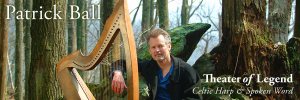
Patrick Ball

Patrick Ball continues to bring the lyrical gift of Ireland to the world through harp music and spoken word.

Anyone who is interested in the sound of the wire-strung harp knows Patrick Ball. A fan of traditional Irish music isn’t a stranger to his name or music. If you are an insider, I am sure you have heard of O’Carolan’s Farewell to Music. This man knows intensity. He knows how to use it to put the audience under his spell.

Listening to his music is a wonderful excursion into the world of imagination. That unique bell-like purity of the wire strung harp or Clarsach has gained worldwide prominence lately and  Patrick Ball is among those spearheading its renaissance. I read his biography and that years ago, this artist was studying to become a lawyer. I guess music finds us even in the most unexpected places and situations.

His music can move you to dance or to weep with its sublime beauty. Such magic contained in this instrument. And such power to move the emotions. Close your eyes and turn off the lights. Let the golden stars sparkle in every note. The  album Wood of Morois is out in 2010. You can learn more about him through the links I attached here.

Website: http://www.patrickball.com/

Facebook: https://www.facebook.com/patrick.ball.796

Additional resource :  http://www.wirestrungharp.com/

Black Rose by Scott Hoye(Track by track album review)

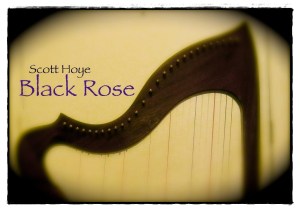
Black Rose: An album  of moods, textures and layers.

I am listening to Black Rose, a Cláirseach harp and vocal album by the  American Celtic  musician Scott Hoye. It has all the satisfying elements that you can find in a traditional album. Yet it has the experimental quality of a New Age  or Ambient album. There is a good balance between instrumental and vocal tracks  here. We find songs that are familiar, including Eleanor Plunkett. His track by track arrangement is eclectic. I hear strains of Liszt in Ultima Thule while other tracks like Oh Rainy Night  just oozes with folk/rock vocal harmonies. Black Rose is an album filled with elegance and emotional beauty. And his influences are very refreshing.

Eleanor Plunkett is played the way I remember Clannad did it in the 70s. It has that same down to earth appeal yet with elegance in its simplicity. It is tied up to Fanny Poer which has percussion and whistle. The ambiance is live. This is exactly the  kind of sound you hear on live acoustic performances.

Scott used to be part of a rock band the  Seranati. Think of Jethro Tull and Traffic. This is evident in his powerful voice that has the crunch of an electric guitar with its remarkable range. But he is being subtle here as he incorporates the Irish Sean Nos style of singing .The Flower of Magherally is rendered in a capella. I heard several versions. One is by Altan and the other is by Anuna. I have to confess Scott’s singing stops you in your tracks.

The South Wind takes us into another instrumental journey. This time we hear the delicate playing as his fingers move from one string to another with an experienced grace. The notes off the harp twinkle like little crystals. Then the tune moves into the poignant melody of Carricfergus. Here the whistle has never been so bitter-sweet. I love how these two instruments complement each other with such subtle ardor.

Black Rose which is the title track is another a capella tune. Again we hear Scott’s strong but expressive voice where he dips from woeful highs to smoldering lows. Partly Gregorian, partly rock, his singing is really magnificent.

A Neansai Mhile Gra  begins and ends with the kind of delivery that is expressive and simply beautiful. This track is very visual. This is the same kind of element you can find in his Celtic band The Spriggans.

Oh Rainy Night takes us into a rock twist with its engaging vocal harmonies. This is the style where he shines. Scott isn’t really for tamed emotions when it comes to singing. Like a wolf that needs the wild, his voice is a force of nature, so stormy yet beautiful with its power.

Where Time Stops is gentle as of a balladeer telling a story. “ I can show you a place where the time stops”..he sings with such ease of expression that when he moves to the chorus with layered voices it becomes epic. I’d call for more rainy afternoons with this song. Like a walk in the fields when the downpour stops, watching the leaves glisten. This is  the  kind of beautiful imagery this song brings to mind.

Sad Nika brings back that Sean Nos air that track 2 and 4 have. With varying arrangements, Scott has created an album  of moods, textures and layers without having to call for a lot of collaborations.

The last track Ultima Thule is a long piece with an almost operatic quality. It is dreamy, hypnotic and it is the kind of music you would like to hear when you are waiting for the rain to stop. I think without this track Black Rose would sound incomplete. Everything about Black Rose simply go together like  forks, knives and spoons. Dinner has been served. And yes it is a rewarding listening experience.

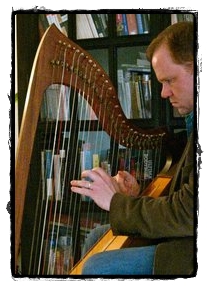
The composer at work.

Blurb about Black Rose from liner notes:

Black Rose has been many years in making. Several of the tracks were written long ago for two other projects, Seranati, a progressive rock group, and The Spriggans, a Celtic ensemble. Both groups performed and recorded in the 1990s in the Detroitarea. These songs did not see the light of day then, and they have simmered on the back burner of my mind over the years. I have re-imagined them for this, my first solo recording. Black Rose has slowly taken shape, like a musical journey with many vistas along the way. It is a fusion of many of the things that impassion me: traditional Celtic, pop, folk, and ambient musical styles.

Black Rose, the tune, was written for a friend when she had hit upon some sad times. I had initially imagined it as a prelude to a tune called Beauty’s Daughters (a.k.a., Lord Byron’s Stanza’s for Music II) crafted by my self and guitarist Patrick Penta, and played by both The Spriggans and Seranati. The refrain was written without my knowledge of the term Black Rose being attributed to Ireland; a sort of code word for the longing for a independent country during the British rule. This was a happy accident, and I humbly offer it up as a new, Sean Nos, or “old style,” a cappella song, like those popular in traditional Irish music. Two other songs here fall in this category: The Flower of Magherally (a traditional Irish tune) and Sad Nika. My friend, singer-songwrite John Hammink, wrote Sad Nika after a hiking trip in Europe. He wrote it for me to sing while I was a member of The Spriggans. I am exceedingly happy to be making it available here now. Thanks so much for waiting, John. Hope you aren’t disappointed with the effort.

Oh Rainy Wind and A Place Where Time Stops were both written for Seranati. Oh Rainy Wind describes my life walking to and from bars with various women, or just walking into and out of pubs on long nights. It was written at the behest of the keyboardist, Stefan Economou. Stefan desperately wanted to sing more bright, pop, rather that dark, blues influenced tunes. Here is your “Beatles” tune, Stefan, re-figured as a three-part, a capella, drinking song.

I like to think A Place Where Time Stops was influenced by Sufi and Hindustani religious, devotional poetry and spiritual traditions. I was also between girlfriends when I wrote it, so I can’t deny the process of sublimation in its inception. Singing in a rock band did have some fringe benefits, I suppose.

Ultima Thule is an improvised theme with multi-tracked harp and whistle. My friend Bryan Moore, sculptor and director of HP Lovecraft film and fandom fame, inspired it, naming his new home after the term. “Ultima Thule” is an idea from the ancient Greeks—the most distant, northerly island, geographically, from their perspective. Perhaps Hibernia? Albion? Who knows? By the time the Romantics referenced it in poetry and lieder, when the world had been fairly well mapped, it was an imaginary country; a land of the dream realms. I thought the pentatonic setting would give it an ancient flavor, as well as lending itself to improvisation.

Eleanor Plunkett/Fanny Poer: two tunes attributed to the 17th century, Irish harper, Turlough O’Carolan. These were both written as slantes, or tributes to two of his patrons. I attempted to give a more “archaic” sound to the arrangement with the inclusion of the descending arpeggios. The second tune includes whistle and djembe, an African hand drum, rounding it out with a full ensemble quality.

The South Wind/Carrickfergus: The first tune is attributed to O’Carolan, but sounds more like a simple folk tune to me, so he may have just grafted his own poetry to an older tune, or it was never really a part of his repertoire. Carrickfergus is a permutation of the Scottish tune, “The Water is Wide.” Dominic Behan, Brendan Behan’s brother, first recorded it, and attributed it to, of all folks, Peter O’Toole who learned in, of all places, a pub; fine couple of folks for a harper to be vicariously connected to.

A Neansaí Mhíle Grá: is a simple instrumental version of this Gaelic love song for the harp.

Thanks to the following for their support and inspiration: Ma & Da and clan Hoye; Dick Anderson of Woodsong Musical Instruments for creating a superior harp that has held up all these years; Eric & Cynthia Cathcart, Rachel Hair, Steve Toth, & Chris Caswell for recording tips, and encouragement; all Spriggans great and small (you know who you are); wirestrungharp.com, my Soundcloud cronies and FB harp associates; John Hammink for writing such a great tune and waiting so long; Regina Harris-Baiocchi for kind words and perspective; Delhi street food vendors, just because you deserve recognition, and Atul Mohan for pointing me in their direction, and providing encouragement for this project; the worldwide Khanna tribe (cheers!), and, especially, my wife Shabnam.

You can purchase the album here: http://www.cdbaby.com/cd/scotthoye

visit: https://www.facebook.com/SCOTTHOYEMUSIC

https://www.facebook.com/groups/celticharp/

and http://www.wirestrungharp.com/