Where East Meets Celtic: Discovering Erhu Virtuoso Guo Gan (果敢)

With Duplessy: peace and harmony in nature.

When I am out riding my bicycle on my rest day from work, my ears also go on a journey. As I mentioned in a previous post, Chinese traditional music feels Celtic-adjacent, and the two styles can easily sit side by side. Chinese erhu virtuoso Guo Gan (果敢) has proven this time and again through his cross-cultural collaborations. The erhu has fascinated me since I was a kid, largely because of the Chinese martial arts films I used to watch and my love for Jackie Chan and Bruce Lee. Much like how food and culture are deeply intertwined, the erhu brings an unmistakable Chinese flavor to any piece of music. Guo Gan has become a prominent figure in the world music community thanks to a rich discography featuring musicians from France, West Africa, and his fellow Chinese peers. Here is a brief look at his background.
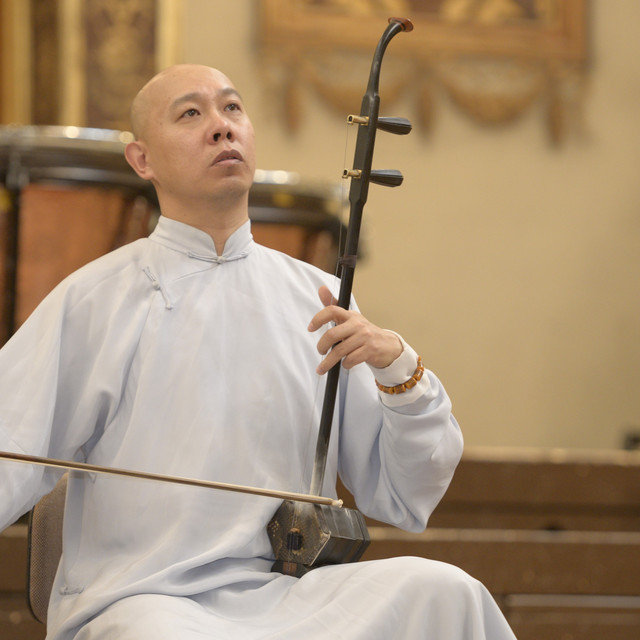

Guo Gan (果敢) 

Born into a musical family in Shenyang, China, in 1968, Guo Gan’s path was heavily shaped by his father, who was also a master musician. His talent carried him quickly through the academic ranks, and by 1995, he was already teaching as a conservatory professor. Everything changed when he relocated to Paris in 2001. Living and working in the French capital for more than twenty years allowed him to act as a musical ambassador between East and West, propelling him onto the international stage and showcasing the erhu as a remarkably versatile, global instrument.

Once settled in France, he expanded his musical vocabulary by studying jazz percussion, eventually earning a master’s degree from the National Music School of Fresnes. Alongside his formal studies, he established Dragon Jazz, Paris’s first Chinese jazz ensemble. His dedication to cross-cultural artistry earned him historic recognition in 2016 when the French Ministry of Culture named him a Chevalier des Arts et des Lettres (Knight of the Order of Arts and Letters). Over the years, his career has spanned numerous film soundtracks and international projects, leading up to his recent album, Mǎ. Among his standout works is his collaboration with acoustic guitarist Pierre Bensusan on the album Vividly, alongside several other notable Breton and Celtic artists.
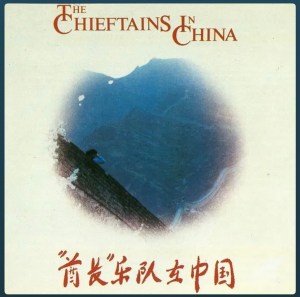
The Chieftains in China (1985)

The Chieftains in China album

Today let us revisit The Chieftains in China album. You might be wondering why I am posting this. I noticed that there is a consistent increase in my traffic from China. And this not strange. Irish music shares a close kinship with Chinese music for several reasons:

Pentatonic scale- the five-note scale makes everything singable and eliminates harsh dissonance. 

Embellishments- The rolls, cuts, and crans on Irish instruments also find similarities with Chinese instrumental playing style.

Parallel instrumental families- There is relative style of playing and sounds such as  found on the Irish harp and the Chinese zither (guzheng), or traditional wooden/bamboo Irish flutes and whistles compared to the Chinese transverse bamboo flute (dizi). 

   The Chieftains in China was released in 1985. Here’s a little trivia: The Chieftains were the first Irish musicians to visit China and the first ever Western musical group to play on the Great Wall of China. So I tried to look for more info about this album and here’s what I gathered and I will quote their Wiki page:

“In 1980, diplomats from the Chinese Embassy in Londonattended Royal Albert Hall for “The Sense of Ireland” festival, where the Chieftains were performing. The diplomats had enjoyed the performance so much that they invited the band to visit China on a musical tour. As China had no embassy in Ireland at the time this was problematic.[4]

When full diplomatic relations between Ireland and China were established in 1981, Moloney planned the trip with Chinese ambassadors and sent copies of Irish music to various Chinese orchestras. The Chieftains were one of the first groups from the West to visit China and became the first ever Western group to play on the Great Wall of China. While in China the group performed with various Chinese folk orchestras, as well as more impromptu performances with local musicians.[4]”

The album has 10 songs and runs for  51 minutes. There is an alternating tempo in each tracks from slow airs to fast tunes. One of their memorable tracks is “The Chieftains in China” the title track played in clàrsach by Derek Bell.

The Chieftains in China is also available for streaming.

Here are the list of personnels: