Photos by Kmax

Oona McOuat (pronounced oo-na mick-kew-it) is a naturalist singer/composer. Her music evokes the Earth Mother‘s embrace, laced with bohemian sultriness and Islander spirit. Her’s is a fresh approach to a genre that has remained stable and vibrant through the years. I am one of the lucky people who is able to listen to the whole tracks off her new album Honey and Holy Water. I have been listening to the songs in small speakers and head phones before expanding to large living room speakers. There are nuances one can usually miss upon a single listen. There are those passages that make you say ” hey I never realize that before”! Repeated listening can have its rewards.
Honey and Holy Water exudes the atmosphere which I refer to as maritime folk music. And popularly, this one is called Eco-Celt. A kind of genre that raises awareness for ecological conditions like the disappearing trees, bees, dying whales and “the world in chaos because we could no longer go back to Woodstock and be with the Earth Children” as one of her song talks about.
She has eclectic taste, which explains the ensemble created in this recording. Cellist Corbin Keep has carved a name for himself as the wild cellist. Other wonderful performers are: Cellist Jami Sieber, Richard Lee on woodwinds,Chris Bertin on percussion, with fiddlers Zav Rokeby-Thomas and Michael Fox and singers James Mujuru and Desmond Sutherland. Producer Daryl Chonka also added bass, guitar,piano,didgeridoo and other beats.
Track by track detail:
1.Mystery : From the first few chords up to her breathy slightly smoky vocals, the songs holds the listener with its poignant melody. In the chorus Oona sings
“Oh Mystery
in you and me,
Like sky and sea
Like Earth and tree.
Oh waterfall
of flowing love,
Pass through our hearts
and show us we are one with all,
with all.
The perky flute flaps all over the song above the sonorous low purring of the cello creating a contrast .
2.Africa: Zimbabwean singer James Mujuru recorded his vocals and based his improvised lyrics poetry and folklore. The African chant and drums accompany her silky vocals.
3. Crystal Maiden of the Lake: Here’s a song with an intro that catches you right away. The cello is plucked in a way to sound like a huge hammer dulcimer. The vocals are layered to create the effect of church choir. Perfect movie soundtrack with strings going in and out like silken sheets. In the second stanza Oona sings:
“Although I long to soar on the nighttime’s velvet wings
and travel to the places where my soul softly sings,
I’m bound to stand upon this shore a teardrop in my eye
to protect the land from human hands for whose misdeeds I cry.” Wow!
4.Ancient Mother: She invokes all the earth mother figures in different mythologies from Egyptian to Celtic.
“Hecate, Demeter, Isis, Astarte,
Diana, Pele, Cerredwin, Kali,
Yemaya, Ishtar, Gaia”…….
5.Drowsy Maggie:A fun track. Traditional Celtic meets trans-continental electro. The irresistible beat makes you want to throw your inhibitions away dancing. Just when you think Oona’s music stays in the same line, it’s then when she tosses her hair and stops taking life too seriously. Just pure fun, goodness and that naughty leprechaun dancing on your table.
6.Green Mountain: After several haunting tracks , this one is a fresh folk-pop tune that glides into your car seat seamlessly. The fiddles provide the unmistakable Irish feel. A great song to listen to while driving long distance.
7.Woodstock: Fellow Canadian Joni Mitchell wrote and performed this song in 1969 . I remember watching a documentary about Woodstock a couple of years ago. I am reminded how the spirit of the 60s were different from now. Gone are the dreamers.
” came upon a child of God
He was walking along the road,
And I asked him, where are you going?
This he told me.
Said I’m going down to Yasgur’s farm
gonna join in a rock ‘n’ roll band,
Got to get back to the land
and get my soul free.”
The Afro-Celt feel of the song makes it Oona’s own.
 8.This is a Prayer: The smoky atmosphere of this song makes my eyes cloudy. And I mean it. The melody simply rips your heart out of your chest. The lyrics talk of lost innocence, a paean to life’s painful passage when we lost that childhood and discover that life hard..but then there is hope somewhere, as indicated by the uplifting sound of the sax. This is the kind of music that Oona should develop more. It is a cool combination that I have never heard from any artist out there.
“There’s a power greater than words
dormant somewhere inside.
Masked behind this gentleness
There’s a rage.” And I say amen to that!
9.Honey and Holy Water: The title track summarizes the whole feel of the album. The mouth harp is also an effective introduction in this hypnotic track that builds up in improvisation. This one also displays her range as a vocalist. Though lyrics aren’t present here. Just her humming along exotic instruments.
10.The Wild Ones:”I’m the wild one that runs with the wind
Thought I could rest here with you my friend
But here they come, here they come.” Here she sings in a higher register. Her vocals emulates Judy Collins and Mary Hopkins. ( One thing to mention – the whale and dolphin sounds in The Wild Ones were not synthesized – they were made by Jami on her cello and by Chris on his drums-Oona).. The tempo is lively and in the end part you can hear sounds of city streets and vehicles honking.
11.Where the Emptiness is Full: This piano based song closes this wonderful album. Again a departure from her usual themes. But then again I realize that no songs ever sound the same. She does manage to keep a holistic approach that makes this album coherent without tracks going in their own way and making their own tea party(which alas mostly happens with other musicians).
She has created a solid base of musicians and a matured crafted songwriting that can stand the test of time. Honey and Holy Water challenges true music enthusiasts to take a listen and be delighted by the bounty of mother earth.
Here’s our Q&A with the artist herself:
CMF: How did you start out as a musician and what made you choose this kind of musical path?
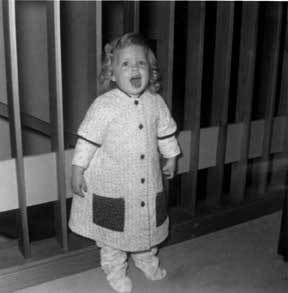
“I’ve been singing since I could open my mouth and make sound”.
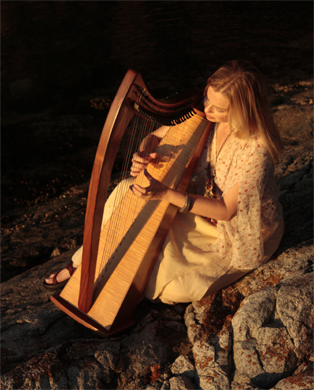
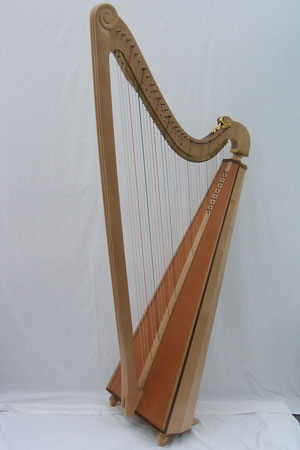
I’ve been singing since I could open my mouth and make sound. (See attached photo!). My mother sensed my innate musicality and love of song and enrolled me in piano lessons. While growing up I also studied dance, music theory, theatre, painting and voice, and wrote stories and songs and poems. When I graduated from high school I had to make a decision- become a classical pianist or explore a world of ideas. I chose the latter and became a journalist. It took 10 years for me to return to a path of creative self-expression. I was introduced to the Celtic harp by a beloved First Nations elder and began to reconnect with my muse.
Are your songs biographical and what inspires you to write the lyrics and melody?
Feelings, hunches, deep inner swirls of sensation, colour and image, set in an inner world beyond, or perhaps beside, physical place and time inspire my lyrics and melodies. Sometimes the words flow from my own experience; sometimes they seem to flow from a collective unconscious that is larger than my own memory or life.
What’s the song writing process?
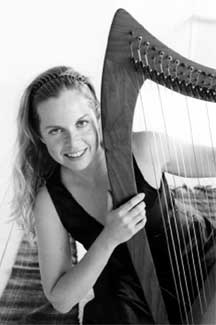
photo by Melissa Schelling
When I am in tune and able to make space I can feel a song coming on. I simply need to sit and the words and melody pour out, generally without effort. I have experimented with other forms of song writing – creating the lyrics first, finding a rift with my hands and then letting the lyrics follow where it takes me, but I think my truest songs are the ones that require the least effort, editing and reworking. I seldom sit down and think – “I want to write a song about….” I simply make room for the song that wants to be created. I have studied song writing and know this is not necessarily the most professional way to practice the craft but it might be the purest. I am soon going to experiment with another way of composing. I want to take a small handheld recording device off into a natural setting and sit and let a song come to me there, away from my instrument.
You have other existing projects with Cellist Corbin Keep. What created this tandem?
I applied to perform at a festival Corbin was curating10 years ago. The gig did not work out but our connection was instantaneous. I invited him to join me on the other gigs I had set up in his area and he agreed. The funny thing is I did this based on our email conversation. This was before he had a website, and I presumed he was a she. I imagined her long flowing hair and cello complimenting me and my harp beautifully. I almost fainted when we arranged our first phone meeting and I heard his very clearly male voice on the other end. But I was right about the way we would complement each other. Corbin’s skilled rhythmic playing and his rock and roll influences are quite different from my soaring style with the harp. Our differences add colour and contrast to our music, blending with our commonalities – our classical training, similar world views and our ease together – to make a great musical match: one with depth, grace and a touch of the unexpected.
What’s the recording session like with your band Dream Deep? Give us a glimpse of the jam that created this sweet album.
Where the Emptiness is full was recorded live – piano, voice, no click track – very straightforward. Honey and Holy Water, the title track, was recorded as a live studio improv. I gave Jami Sieber a verbal image of what I wanted the piece to represent, she began with a cello lick, I sang live over top, she added another cello lick and our conversation began. We created a 20 minute improvisation in the studio that eventually had to be edited down to 5 minutes or so. Before the editing began, two digds – played by Daryl Chonka and Chris Bertin – did their own studio improv on top of our tracks. I added a bit of harp at the very end. The rest of the songs were recorded in a completely opposite manner. I laid down the harp tracks to a creative click track created by Daryl. Then we laid the vocals on top. To record the vocals he brought his equipment here to my little cottage and I sung all the songs in my own home. We then decided what we wanted where, and invited Chris, James Mujuru, (who is now living back in Zimbabwe), 6 year old Desmond, Corbin, Jaime and Zavellenah Rokeby Thomas to each come into the studio for a session to layer in their parts. We did not tell them what we wanted them to play or sing specifically but gave them images to illustrate with sound. Richard Lee recorded all his woodwind and vocal parts in a studio in Hawaii and Mike Fox recorded his violin tracks for This is a Prayer in his bathroom in Brazil. I think the reason remote recording worked so well with them is that we have played together live for several years so they were able to seamlessly drop into the songs. Daryl then added finishing touches – always thinking that less is more – and we began mixing and remixing and remixing until we were both satisfied with the songs and the album.
You travel a lot and Mystery was inspired while you were in Hawaii. What are other places that you’ve been to?
Europe, the Southwest, the North, the Maritimes, all across Canada, the Eastern United States, the West coast, Mexico and Central America. Generally, I am more concerned about our relationship to the natural world than to specific geographical locations. That being said, sometimes a song will arise from a specific place and express itself through me in ways that stretch and illuminate me musically as well as personally. I think this is the best of what travel offers us – as we journey to a foreign place and experience new things, we may come to know and appreciate the familiar in fresh and meaningful ways.
Before your foray into music, you were into theater . You also served as a war correspondent and a wild dolphin swimmer. Do you think being a journalist inspired you to write some of the most moving songs in this album? Because reading through the lyrics you tend to deal with the human condition . Something that I really care about too.
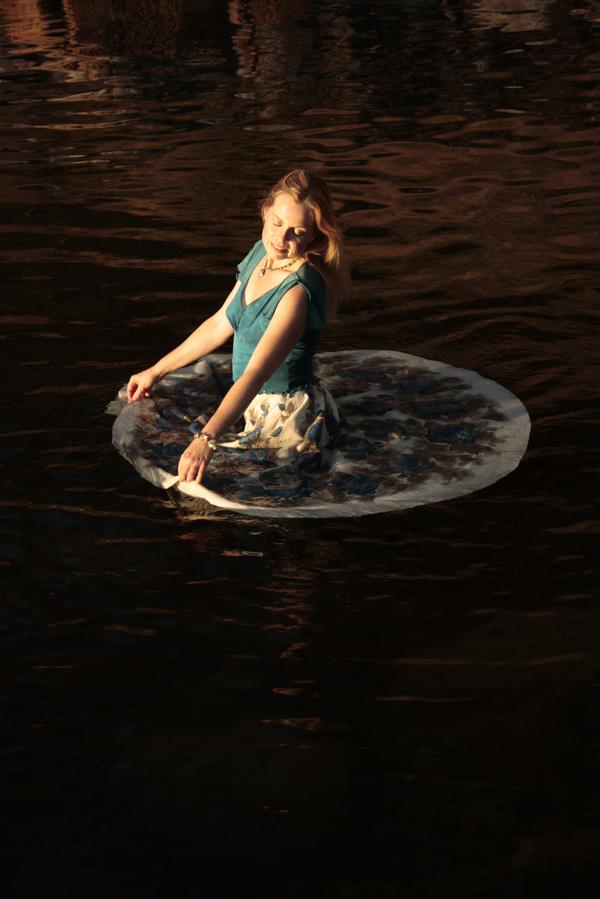 I am glad we have that in common! I think I became a journalist because I cared about the human condition but I did not remain one because I realized that for me, the best way to make a difference was to write and perform songs and stories that could touch people in ways that facts and figures and analysis could not.
It is interesting also to note that you are from the west coast since a lot of Celtic music is concentrated on the east coast. What can you say about this?
I hope and believe my music is not bound to a specific geography. I do perform some traditional music and have studied Celtic harp, Gaelic and traditional Celtic lore in Scotland and Ireland, but I think my gift is to synthesize what has been with what is. I definitely have one foot rooted in the mists of Avalon and yet I am interested in creating music that responds to the current set of challenges facing humankind and our planet. How do we live in balance with a natural world which sustains us while we are destroying it? How do we connect more deeply with each other and ourselves when those of us who have money do not seem to have any time and those who do not have money or their fair share of the resources are forced to focus on surviving rather than thriving?
Canada is an eclectic-friendly nation and a lot of my favorite musicians came from your country. Have you met some of the notable musicians in the genre and what it’s like?
Canada has traditionally had a strong history of nurturing and supporting the arts which has allowed musicians and artists to flourish. Until now, the Canadian voice has been strong in folk, pop and contemporary Celtic music – ie: Loreena McKennitt, Natalie MacMaster, Ashley MacIsaac, etc – partly because there were mechanisms in place that supported touring and recording. This is not the case here in British Columbia now where government funding to the arts has been drastically cut.
I have played at the same festival as Bruce Cockburn and the Rankin Family. I’ve received career guidance from Sarah McLachlan’s producer Pierre Marchand. I have shared a stage with Ferron – a great Canadian singer songwriter. I recently shared a stage with folk music legend Valdy who lives down the road. My album was mastered at Randy Bachman (of the Guess Who’s ) recording studio. I have enjoyed meeting all these “greats” and learning from their skills and I believe that those who were successful in the music business of the 70’s, 80’s and even the 90’s may be less able to support or mentor emerging artists now than other indie artists who are walking the same path. We do not have a team of publicists or managers or record label personnel to take care of all the details for us. We must focus on the business aspects of our careers while maintaining an authentic relationship to our craft and our fans. So although I love absorbing the creative gifts of these successes, I believe indie artist are in the midst of living and building a new paradigm.
What’s it like to work with producer Daryl Chonka in this album?
I had literally traveled half way across the world in search of the right person to create this album with and, as it turned out, I found my producer within walking distance of my own front door. The album was recorded in a tiny studio in the beautiful valley where Daryl and I live. Last winter when we were snowed in for a month, Daryl and I hiked over the mountain between our homes and met halfway so he could give me a copy of his latest mix. Daryl plays several instruments on the CD – bass, piano, guitar, beats. He subtly helped shape the sound of the recording without adding anything that felt out of sync with the project.
Tell us things we don’t know yet about you.
Ah – I’m a Scorpio and we like to remain a bit mysterious but…I have family visiting this Easter weekend and last night we played a game which I will share with you. We each made a list of 26 words that felt true to us, each word beginning with a different letter of the alphabet. Here’s my list:
Attics, Bach, cetaceans, dancing, effervescence, flow, giggling, hugs, ideas, journeys, kookies, lambs, miracles, nettles, oceans, pumpkins, questions, results, stories, truth, unicorns, vastness, whales’ song, xylophones, yoga, zip.
Interesting list words. It’s hard to top those 🙂
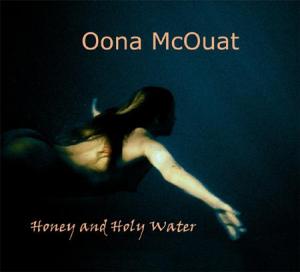
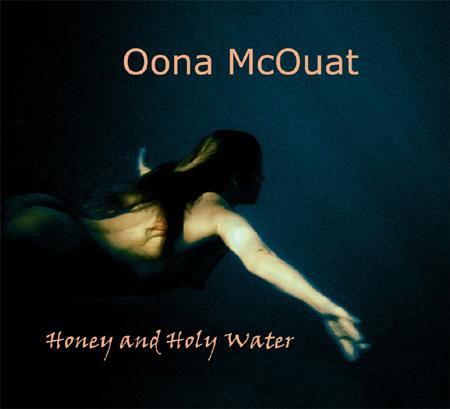
Album front
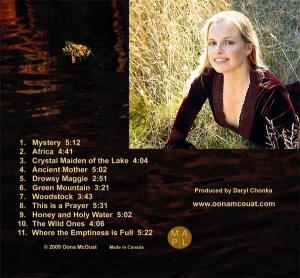
Album back
http://www.oonamcouat.com/
http://www.myspace.com/oonamcouat
http://www.cdbaby.com/cd/oonamcouat
http://www.reverbnation.comww.reverbnation.com/oonamcouat
0.000000
0.000000
Help this site by sharing this post:




 Celtic Music Fan
