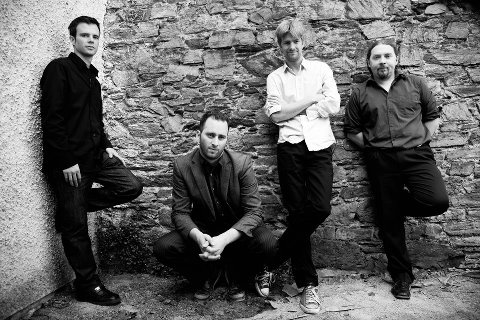
The guys of Tremolo are geared up for their performance at The Black Box in Belfast this Monday 23rd, and Whelans in Dublin this Thursday 26th. I have been following them since they came out. You Dublin people are so lucky. Folks don’t miss them. I am sure they will give an ear-widening and jaw dropping super performance!
This entry originally appeared in The Celtic Music Magazine . I have Marc Gunn’s permission to re post it here. I think this is an interesting essay about how Celtic music found a home in the Czech Republic. I remember the first time I went online(after discovering the Internet), I met a couple of friends from over there. They are from a band called WMV Trio. After 2000, life took over and we all drifted apart. But memories are precious and I still recall the great times we had sharing music, poetry and everyday things.
Robots, bagpipes and Celtic music
by Jeremy King
Here’s a little quiz for you. What do the following have in common? Skoda cars, robots, pistols, and Vaclav Havel. Got it? They’re all Czech. Really? Mr.Havel and Skoda cars, sure, but robots and pistols? Both are Czech words which have been completely assimilated into the English language. Now, if I were to add to this list of things Czech ‘bagpipes’ and ‘Celtic music’ you might start to question my state of mind. Too much strong Czech beer, perhaps. Nope, not at all. Bagpipes have been used in the Czech lands since time immemorial and Celtic music, well, the pipes and Celtic music are inseparable aren’t they? Find more about Czech bagpipes here And, unlike those Czech words which have been assimilated into the English language, Celtic music hasn’t been assimilated into Czech culture; it’s always been here.
Central Europe has long been known to have nurtured the Celtic tribes which later migrated across the rest of Europe, taking their bagpipes with them, to end up in the Atlantic coastal areas of Spain, France, Wales, Scotland and Ireland, and then finally, much, much later, in emigrant ships to America and Australia. Of course the music and culture and the bagpipes of the Celts changed, adapted and diversified as the tribes spread out on their millennia-long journey, taking on influences from the tribes and lands that they passed through and inhabited. So here we come back to the idea of assimilation. It’s always been a two-way thing, this cultural exchange between peoples living in close proximity. It’s something us humans do well. It’s a way of showing off, but it’s also a way of making friends. Let’s take a modern example-just think about that song by Aerosmith and RUN DMC- ‘Walk This Way’.
You may not like it, or you may love it. That’s not the point. The point is that it’s a great example of how two vastly different styles of music (metal and hip hop) played by musicians from very different musical scenes got together and had a load of fun creating a great piece of music. I’m sure you can think of lots more examples in Celtic music. One springs straight to mind; the Afro-Celt Sound System . There’s another example of how very different musical styles meld together and create something exhilarating.
This is all quite a long way from the Czech Republic and Celtic music, though. When people listen to our music they are usually surprised to find out that we’re from the Czech Republic.
Poitín
For those of you whose geography is a bit fuzzy, I should say that the country has Germany and Poland on its left and right, and below it on the map you’ll find Austria and Italy. Naturally, people quite justifiably want to know how it is that we are playing this style at all. The first thing we usually say to these inquisitive souls is that we like it, which should go without saying, really. So then they ask, but how did you get into Celtic music in the first place? And for the majority of the band it is the same answer: via Czech folk music. So here we are again. We’ve come around full circle. So what is it about Czech folk music that connects with Celtic music? Bagpipes for one thing.
But there’s more than that, of course. Czech folk music still resounds with the echoes of the music of the ancient Celtic tribes that once lived here. And some musicians aren’t content with regurgitating fossilized folk tunes. They want to move on and create something new, whilst respecting the traditions from which they have grown. Music schools in the Czech Republic have a great and well-deserved reputation. Many parents send their kids to after-school classes to learn the violin, piano, and even traditional folk dance too. My son goes twice a week to a very patient and lovely music teacher to learn the accordion- he’s going to play with us one day. And in these classes they naturally learn to play Czech folk music. Our bouzouki/banjo player Honza and guitarist Kuba both went to Folk dance and music classes – they have fond memories of attending folk festivals around Europe when they were children and where they were treated like stars. But for some, Czech folk music is just a starting point or a stepping stone to something else. Many children don’t carry on with music at all when they get older, but those who do either continue with their Czech folk music and play in wedding bands and so on, or else move on to other musical genres. And it is this last group which we’re most interested in, as a lot of these musicians seem to gravitate towards the very broad genre known as Celtic music.
Next time I’ll be looking in more detail at Celtic music and culture in the Czech Republic, from the traditional to the experimental; from bands which sing traditional Irish songs translated into Czech, to bands which have given a modern twist to traditional Czech music; bands which have gone into Celtic rock, punk and metal; I’ll also look at some Scottish and Irish dance companies based in the Czech Republic which compete in international competitions. There is a lot to discover here in one of the world’s oldest Celtic countries and I’m looking forward to sharing it with you.
Poitin and Sliotar performed together at Zach’s Pub earlier this week. It was an amazing musical event. Here is one video taken by the flutist of ” Cheers!” Kateřina Hofmanová.
The low whistle introduced me to the world of Celtic music.
Two instruments that introduced me to Celtic music : Low whistle and uilleann pipes. After that phase everything started happening and now I am here! Every now and then, I get recommendations from friends who are professional recording artists. They would tip me saying ‘ hey this is cool, listen to this track/video”. Just to give you an idea that I am not the only one looking for something interesting out there.
Yesterday I had a great conversation with Jeff Ksiazek of áthas about doing an interview for this site. I thank my friend, the harpist/singer Scott Hoye for the opportunity of not just meeting some of his friends but also for this amazing video.
Cormac Breatnach is an amazing low whistle player isn’t he? Hearing him speak in musical Gaelic made me regret about my slow progress with the language. Like I said low whistle is one of the instruments that introduced me to Celtic music. Listening to this track has its rewarding moments in term of nostalgia and the enjoyment of seeing someone play with such passion.
After a few days of trivia and news about tours and album reviews, it is time to relax and listen to an artist. This is one of the things about my writing that I take delicately. Knowing an artist can sometimes be an illusive thing because you might just be talking about a certain point in an artist’s development. There are times when the challenge of getting the right material is ever present.
Harpist Corrina Hewat is an artist that tells you right away to expect the unexpected. Just hearing the first few bars of the percussive Suntrap and Ratman told me that I have to take aside my long-established notion that all harpists sound in a certain way. Well, her sound has that distinctive Celtic flavour but there are also elements of jazz , classical and world music. This is an artist who listens to Le Mystere Des Voix Bulgares, Ella Fitzgerald, Nirvana, Earth Wind and Fire and Debussy among others. Vocally, her impressive range shines like satin sheets. It gives you that relaxed feeling. Like night flowers, wine and the cool breeze. Things that intoxicate the senses with promise.
Expect jazzed up traditional tunes played through her crystalline harp sound.
Within a few minutes of hearing her, the energy and the timing, the depth and the colour of her music will touch you. One of the leading Scottish Harp players in the world today (nominated Instrumentalist of the Year 2004 at the STMA) Corrina has toured through Europe, the Far East and Canada taking the Small Harp to a new level of excellence, combining traditional style music with contemporary attitude. She is also blessed with a stunningly earthly voice, which resonates with years of soaking up Scotland’s musical tradition, while exploring contemporary elements and jazz. She is in demand as a player, composer, arranger and teacher, and her appeal grows larger as more and more people hear and meet her. She has an astonishing ability to create and collaborate with others and this has led her to recording over 30 albums in the last twelve years. She plays a Camac Aziliz Harp (she calls it ‘Little Yellow’) and the “Big Blue” electroharp.
Corrina Hewat is co-founder & co-musical director of the extravagantic 22-piece Unusual Suspects – the folk big band dubbed The Scottish National Folk Orchestra “one of the most exciting bands I’ve ever seen” quote Mike Harding Radio 3. She is also a skilled and innovative composer and arranger, having written many large scale commissions, while also musically directing shows such as ‘Voices of the World’ 2008, ‘Songs of Conscience’ 2007, ‘Scottish Men’ 2006 and the TMSA Young Trad Tour since 2005. Corrina is a founder member of distinct bands such as Bachue, Chantan and Shine and has been involved in awarding winning and pioneering shows such as My Ain Countrie and Scottish Women.
Recent projects include a duo with Kathryn Tickell, exploring the Scottish and Northumbrian Borders traditions and vocal trio Grace, Hewat, Polwart with Karine Polwart & Annie Grace. “The world needs to hear this!”
Corrina is also developing her own one woman show for tour, incorporating a range of original and traditional music, songs and stories from her background growing up in the Scottish Highlands through to her surroundings now in the Scottish Borders. She is a stunningly versatile singer “She blends a jazz singer’s flexibility, a blues singer’s economy and a folk singer’s heart into a style that’s both natural and her very own” with an incredible range and velvety tone while also possessing a creative and powerful technique on the harp, both on the Scottish small harp and electric harp. “A range of expression and depth of technical assurance… dazzlingly nimble finger work and liberal deployment of the instrument’s big bass end”.
Corrina’s teachers in college were Sanchia Pielou and Maire Ni Chathasaigh whose tuition and style she still refers to today. She is a core tutor on the Traditional Music Degree courses at Newcastle University and the RSAMD, as well as teaching workshops and courses on harmony singing, arranging and vocal techniques.
Her recently published music book, with accompanying CD, ‘Scottish Harp’ has received critical acclaim from teachers and pupils alike. It comprises of traditional-style pieces and compositions for solo harp (Taigh Na Teud music publishers http://www.scotlandsmusic.com). Her second book is due out in 2008.
She also has six 30 minute videos available for download on for intermediate players. www.ayepod.net
DETAILS DETAILS…
Born in Edinburgh 21st December 1970
Brought up on the Black Isle, Ross and Cromarty, Highlands of Scotland
Noriana Kennedy: for anyone who likes, Trad, Folk, Bluegrass & Old Time Music. I find her style of singing very fresh. It is a nice video and music considering this is a live recording. I wish Noriana Kennedy more success in the future.
With Noriana Kennedy, Nicola Joyce & Noelie McDonnell
Written by Noriana Kennedy


 Celtic Music Fan