A tribute to the guessing game that has launched a thousand ships.
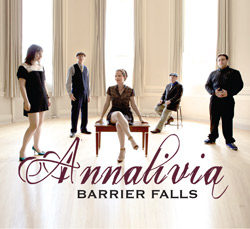
The band Annalivia have an amusing history for me personally. It started out as a guessing game that my friend Jimmy gave to everyone. He took snippets of When I Was In My Prime off their debut CD. I was partners with Tim. We took the game really seriously and worked on it doing research on the web while chatting. We won beating other competitors. For the prize we both got the sophomore CD Barrier Falls.
I think I waited weeks for it to arrive in the Philippine post office. It created problems on Jimmy’s side but in the end I really got it. A wonderful CD with awesome artwork and packaging-and of course a wonderful message from my pal.
The sound production is exquisite and I think producers Matt Brown and Flynn Cohen did a good job in making the album sound slick without sacrificing the organic quality of the music. The thundering opening track Reynardine really set the mood for what’s to follow. Personal favorites are songs like John Riley showcasing energetic guitar strums and commanding fiddling performance. Early in the Spring sounds optimistic and the pizzicato, soft vocals and nice tempo really get to your mood that makes you want to open your windows and let the early morning brightness in. Time is Up on the other hand is poignant and ingratiating. I think all tracks are excellent in this album. I really enjoyed the guessing game and also getting the CD!
The Outside Track is a multinational traditional folk band from Ireland, Scotland, Cape Breton and Vancouver featuring Ailie Robertson (harp), Fiona Black (accordion), Norah Rendell (vocals & flute), Mairi Rankin (fiddle & stepdance) and Cillian Ó’Dálaigh (guitar & stepdance)
Thanks to my friend Christi of Talk and Chatter for sharing this one of a kind multi-national band. They just don’t sit and play, they also move around in those amazing dance steps. Find them here:
Generally we have an idea in our heads of what sort of ‘feel’ we can imagine for a song but sometimes it ends up being totally different to the first template! For instance, in ‘Gazz’, that developed from Roberto playing a riff on the upright bass then each of us just joining in with some little snippet, then I threw in some odd Gaelic words which then developed themselves into a wee new genre- Gazz- Gaelic Jazz! It’s great fun as well as being completely inspirational, working with the others.
Gaelic/Traditional Vocalist/Member of The Kilmarnock Edition talks to The Celtic Music Fan about her new exciting musical project.
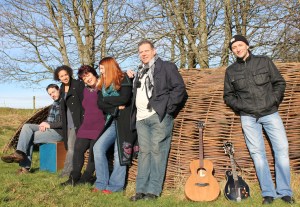
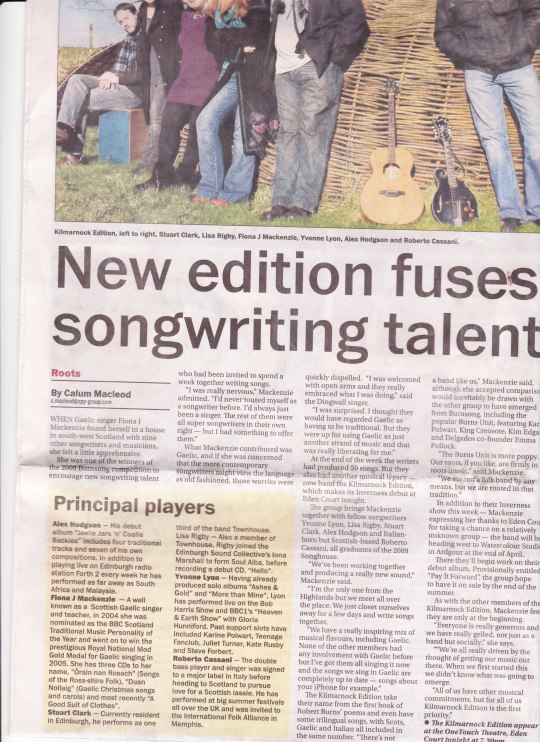
So excited to feature this band from Scotland. I follow Fiona Mackenzie’s update so that’s how I was able to read about The Kilmarnock Edition. What got to me was their reggae sound on top of the distinctive Scottish trad tune. And yes folks ’tis the season to party! I set this interview up to know more:
1. After your last album A Good Suit of Clothes which I enjoyed so much, this is one good news! Your voice is really beautiful. What is the most exciting thing about The Kilmarnock Edition?
The most exciting thing about being part of the KE is the realisation that we are bringing a new style of Scottish music to the public ear. We are all well known in our own individual genres but as we work together, we are creating something that I think is very special and that wont be found anywhere else on the Scottish music scene. We are thrilled to have the chance to work on establishing what is in effect, a new genre of Scottish music- we are not a folk band, we’re not a classical band, we’re not a rock, jazz or reggae band- but we have elements of all this within our style- but it doesn’t emerge as if we are a real ‘hotchpotch’ of sound, the music presents itself as an exciting, hopeful and inspirational style, all of its own.
2. The members are high-powered coming from their own bands and projects. Is it a great experience working with the rest of the band?
It is hugely exciting with the band. We all manage to get along together very well socially as well as professionally and we have formed very strong personal bonds, as well as various other duo/trio partnerships for other gigs. Everyone is very generous with their Songwriting and willing to ‘let their songs go’ to others in the band, for vocals, instrumentation etc if they feel that is what the song needs. When we get together for writing/rehearsals we are always very excited to see what the latest sounds will emerge- we never quite know what’s going to happen, but we do know when its right! We are very lucky to have such a diverse range of talents within the group, both musically and in writing. Roberto for instance, is hugely talented at writing funny, observational but very incisive songs about normal day to day life, which are really brought to life in his own Italian accent and style. Lisa writes beautiful songs about the world today, political/socio-economic environments as well as taking history as inspiration for example. Yvonne writes truly stunning lyrics of life and love and gives us the gift of her beautiful keyboard skills. Alex writes wonderful songs which are easy for audiences to pick up as well as the most tender of love songs. I write contemporary songs incorporating Scottish Gaelic with English and the Scots tongue- on contemporary subjects such as technology and ‘empty nest syndrome’! It gives me the chance to experiment with new ways of making Gaelic accessible to a wider audience. And Stu, our cajon player and percussionist gives us that fantastic extra brilliance of beat for whatever the style and tempo.
3. What can we expect from this project musically?
Musically we want to show an audience that Scottish music does not have to be traditional to be representative of our language and culture. That is is possible, in the hands of good musicians and writers, to take elements from all aspects of the Scottish musical spectrum and blend them into something new, fresh and invigorating, a new face of Scottish music. All members of the band are well established and well respected in their solo careers and we only perform to the highest professional standards. We are all passionate about what we do and we believe that is evident in our performance.
4.Is there an album coming out soon?
We will be going to Watercolour Studio on the lovely Ardgour peninsula at the end of April to record our debut album “Pay it Forward” and we are hugely excited by the prospect of working very very hard at producing what we hope will be a truly special and indigenous album. We are totally delighted and honoured that the album will be released on the Greentrax label and we are very grateful to Ian Green to having faith in us to produce an album for his catalogue. He has been following us since our first rehearsals and says that he did indeed spy something unique about us right from the beginning. We take our title from the fact that , having been lucky in being given support from various people over the last 2 years, we now want to ‘pay a little forward’ and do something for other people or groups in the Community. To date , we’ve done some local charity gigs to raise money for the new Church roof in Prestonpans, where Alex comes from.. The album will be out during the Summer.
5. I heard a few sample tracks and I understand what makes the band exciting. The tracks are really groovy and good enough for dancing. I am sure fans of Reggae, Traditional music as well as Jazz will love the music. Who lays down the musical ideas for the tracks?
All the ideas for the tracks come from ourselves. We bring an idea to the group then just jam for a while until something gels then we work on that basic idea. Its often easier working with others than on your own as you can bat ideas around and someone will play a wee riff or sing a ‘doo wop’ that sparks something interesting and unusual. Generally we have an idea in our heads of what sort of ‘feel’ we can imagine for a song but sometimes it ends up being totally different to the first template! For instance, in ‘Gazz’, that developed from Roberto playing a riff on the upright bass then each of us just joining in with some little snippet, then I threw in some odd Gaelic words which then developed themselves into a wee new genre- Gazz- Gaelic Jazz! Its great fun as well as being completely inspirational, working with the others. We’re all so thankful that we met in the Burnsong House in 2009- Kilmarnock Edition has given all of our musical careers a totally new direction and hopefully it will take us to all parts of Scotland, the Uk and to further afield too- we really do believe that overseas markets will find out new style of Scottish music, appealing whilst still drawing on our traditions and respecting where we come from.
I love essays.One of my favorite writers in terms of essays is the late Anthropologist Loren Eiseley. There is something about a person relaying his personal experiences that is intimate and poignant. Alasdair Roberts together with Mairi Morrison released a wonderful album called Urstan. Since Drew of Drag City records was wonderful in getting the album to me to provide an inspiration to my review , I asked him if it is possible for Alasdair to commit as a guest blogger. I was so happy when I got a yes.
I think an exploration of the idea of the ‘Celtic’ is something which has cropped up in my work over the years – although I don’t speak the language, I know that a couple of generations back my paternal ancestors would have been Gaelic-speaking, and a lot of Gaelic music exerts a profound emotional impact upon me. It was something I had been exploring in my own right before being approached about the idea of collaborating with Mairi on ‘Urstan’ – mostly through listening to a lot of old ‘field recordings’ of traditional Gaelic singers.
For as long as I can remember I have been singing: my earliest musical recordings were done on a small tape recorder when I was about 7 or 8 years old, me improvising songs on a tiny Casio keyboard. That would be the mid-1980’s and I still remember that as a glorious time for pop music. My sisters and I would watch Top of the Pops every week and particular favourites were Erasure, the Pet Shop Boys, the Communards and Boy George. I remember being into some bad hair metal too – Europe’s ‘The Final Countdown’ of course. My primary school class played recorder all together; for a while I took bagpipe lessons too. In Scotland you begin on the chanter, which is just the pipe part of the bagpipes without the bag. My teacher was a slightly creepy fellow called Mr MacLeod; he put me off, and I couldn’t keep my fingers straight enough anyway. I love to listen to pipe music nowadays, particularly piobiareachd, the ceol mor, the great ‘classical’ music of the Highland bagpipes – but actually playing that music is another thing entirely, I imagine. It struck then and still does as a scary and rigid militaristic kind of world. Macho. But sometimes the visceral ancestral pull of piobiareachd takes hold of me and nothing else quite has the same impact as a listening experience. With all due respect to Tony Conrad, et al, the Gaels of Scotland invented minimalism in the middle ages. If you want to hear and read more, check out Allan MacDonald’s CD ‘Dastirum’ and Donald MacPherson’s CD ‘A Living Legend’, both available on Siubhal Records (www.siubhal.com). Siubhal is the label of a friend and one-time collaborator of mine, piper and educator Barnaby Brown. His label produces beautiful and informative CD packages with extensive notes – lots to absorb.
I disliked music lessons in high school. I feel like music was very badly taught and that probably put a lot of people off. There was no room for creativity, exploration, expression… very little of people actually playing together and sharing. More just rows of bored kids with headphones on working their way in solitude through books of twee tunes on electronic keyboards, with the music teacher watching like a hawk. If anybody deviated from the book, dared to improvise, there would be trouble for the unfortunate free-thinking child. I was lucky to have good piano lessons for a couple of years from a local woman, Mrs Hopper, although I must have been infuriating as I wasn’t the most conscientious student – and later I had guitar lessons from a great teacher which was helpful in showing me the rudiments of musical theory, although I don’t think the way I play guitar now was very much influenced by my teacher’s style. He was a great jazz guitarist but I never worked hard enough to develop those chops. The way I play more like how my father Alan used to play, and influence of a more British kind of folk/traditional finger style tradition can be discerned in it, absorbed through listening to players like Nic Jones, Martin Carthy, Dick Gaughan and so on. Alan used to play with the well-known singer and fiddler Dougie MacLean – he was a great accompanist of fiddle tunes, as you can hear on the LP ‘Caledonia’ by Alan Roberts and Dougie MacLean and on the LP ‘CRM’ which he and Dougie recorded with the legendary Scottish folksinger and bon viveur Alex Campbell (both were released on Plant Life Records).
Around the early nineties or so, in my early teens, I was becoming more discerning about the kind of music I liked and identified with. The John Peel Show was a real lifeline to an adolescent boy in small town Scotland – a great way to hear all these exciting sounds from places which were probably a lot more interesting and happening than my small town. I was very into all American ‘underground’ bands who came up in the wake of what they called ‘grunge’, but the bands who I regarded as doing something more interesting, subtle, thoughtful and artful than the grey (and again often oppressively male and rockist) sludge that that music often was. Slint, Codeine, Pavement and such bands. Another lifeline was the music paper Melody Maker. If one couldn’t go to these gigs, couldn’t witness the Riot Grrrl explosion taking place in exotic London and Brighton, for example, then one could at least read about it all. I remember hearing the music of Will Oldham, who has gone on to become a friend and label mate – for the first time on the John Peel Show – he played The Palace Brothers first single ‘The Ohio River Boat Song’ and it struck a chord with me. I used to tape Peel’s shows and listen to my favourite tracks over again. I remember my father asking me one day whose version of ‘The Loch Tay Boat Song’ I had been listening to – I didn’t realise at the time that Will had taken an old Scottish song and Kentuckified it.
In the village where I grew up there were two woollen mills – well, defunct woollen mills which had by then become tourist traps for the legions of English and American holidaymakers making their way up to the Highlands. The giftshops sold tartan, shortbread, woolly jumpers and scarves, plates with Highland cows on them, spurtles for stirring porridge and such like… and they tended to pipe ‘Scottish traditional music’ through their tinny sound systems. It was all bucolic sentimentality and corniness in comparison to whatever John Peel was playing or the urbane writers of the Melody Maker were writing about. What I would come to regard as the ‘kailyard’ end of Scottish music – twee tartan kitsch. It was off-putting. Of course, later I came to learn more about the ‘real’ traditional music of my nation – the great singers and musicians, the like of whom can be heard on the ‘Whaur the Pig Gaed on the Spree’ compilation of Alan Lomax’s 1950’s Scottish recordings which I compiled at the invitation of another Kentucky gent, Nathan Salsburg of the Centre for Cultural Equity – and that was another formative experience. To come to terms with a ‘genuine’ indigenous traditional song which I now regard as a bedrock which will continue to inform the music I make for the rest of my life. You’ll notice that I have put cautious speech marks around the words ‘real’ and ‘genuine’ as they are of course highly fraught and problematic terms – but if you’d been in Kilmahog Woollen Mill in 1993 and heard the kind of crap they were playing which passed for Scottish folk music, you’d understand a bit about where I’m coming from.
There was also a pub in the town I grew up in which would have occasional ‘traditional music sessions.’ I found these off-putting too. It was competitive and, again, macho. I remember a certain accordionist who used to come along and plug his accordion into a huge and nasty amplifier with a built-in drum machine and proceed to play along with yet completely drown out everyone else in the room – not only his long-suffering fiddling partner but also my father Alan who would sometimes join in on acoustic guitar (the guitar which I inherited when he died in 2001 and which I still play) – and me. I had been playing electric guitar for a year or so, was still learning, and one time went along to join in this pub session – only for the bullying accordion player to tell my father not to let me play any more as I wasn’t good enough. It wasn’t very encouraging and that, combined with the kailyard music blaring in the woollen mill shops, was enough to put me off any desire to engage with or further explore Scotland’s folk music for a long time.
Appendix Out began when I bought a four-track tape machine with money I’d saved from working in a Chinese restaurant in my home town of Callander in about 1994, the year after I left high school. I’d started writing songs shortly before then and had borrowed machines from friends to record things, but as soon as I could afford one of my own I made the long trip to the big city of Glasgow to buy one from Sound Control on Jamaica Street (most of my trips to Glasgow as a teenager were to do with music – to go to gigs underage at places like King Tut’s and the now long-gone Plaza at Eglinton Toll, where I saw Throwing Muses and, on a separate occasion The Palace Brothers sharing a bill with local heroes Teenage Fanclub) and to visit John Smith’s Bookshop on Byres Road with its great music department). Most of my spare time as a 17- and 18- year old was spent in my bedroom recording things on my four-track – songs, tunes, sounds and noises, experiments, mostly alone but sometimes joined by my younger sister Nina on drums and often by my old school friend Dave Elcock on bass guitar. This was the time of something, a movement, perhaps, that the kids used to call ‘lo-fi’ and I embraced it wholeheartedly, relishing the hiss and dropout of cassette tape. My old four-track is now broken and sadly missed. I still have all the tapes I recorded as a teenager and at some future point in an indulgent moment I’d like to go through all the recordings to see whether there’s anything at all worth salvaging. I used to give demo tapes to musicians I liked – it was through this connection, giving a tape to Will from The Palace Brothers at that Plaza gig in Glasgow in 1995, that I got involved with Drag City Records.
I moved to Glasgow when I was 18, to study English literature at the university, but I wasn’t a particularly conscientious student. A lot of my time was spent getting involved with the local music scene, playing at places like The 13th Note on Glassford Street and Nice n’ Sleazy’s on Sauchiehall Street, sharing bills with Glasgow bands of the time like Eska, The Yummy Fur, Lungleg, The Blisters (featuring a young Alex Huntly who went on to change his name to Kapranos and have great success with Franz Ferdinand), a very early incarnation of Mogwai and others. I had put a message up in the student union, listing all the bands I thought were cool at the time, looking for a drummer. That’s how I met Eva Peck, an American woman who would be the first drummer in Appendix Out. We were joined by Yorkshire woman Louise Dowding on ‘cello and my old school friend Dave Elcock on bass. The line-up of the group changed over the course of three albums before the name was finally abandoned in 2001 or so. It was ostensibly ‘folky’ music in that the instrumentation was predominantly acoustic and the songwriting was informed by some kind of intuitive feel for older musical forms, the kind of things I would have heard growing up from my father’s record collection, amassed through his years of running a booking agency in Germany (along with my mother) for Scottish, English and Irish folk acts… but a bit skewed through my punk instincts, fondness for John Peel’s show and also somewhat informed by my literary studies and interests (although, as with piano lessons, I was not at all a conscientious student). There was also a strong element of nature mysticism to the work, something which I would perhaps now regard as distinctly ‘Celtic’ and tapping intuitively into things like the veneration of trees, rivers, lochs and mountains, which was certainly heavily informed by growing up among all of those things in the Scottish countryside. That aspect of the work, the ‘folk’ and nature-mysticism elements, seemed to set apart our music in the Glasgow scene of the time which was a lot more edgy, art-school and urban. The nature mysticism remains in the work to this day but modified and tempered a great deal by years of living in a city reality and just the fact that I’m now in my mid-thirties instead of in my late teens.
I never studied music (as the ‘cellist Louise did) which is something I regret a bit – although I suppose it’s never too late – but I do remember often thinking back then that the people I met who were actually studying music tended to be the most square and least open-minded about music in general. Maybe that was a misconception, but that’s how I remembered feeling at the time. I am an autodidact: apart from some guitar and piano lessons, most of my musical knowledge, both in terms of various musical histories and in terms of technique, theory and so on, has been self-taught, which probably means that there are huge gaps… but there is a lifetime to fill those, I suppose. There is always more to know.
The first Appendix Out record ‘The Rye Bears A Poison’ was recorded at Riverside Studios in the south side of Glasgow in January 1997, while all of the group were still students. I was 19. Artistically, it was one of the most exciting times of my life up until that point, having a chance to realise musical ideas in a proper recording studio rather than at home on a four-track cassette recorder. It was great to work closely with the engineer Johnny Cameron on that session in that freezing and quiet January in Glasgow.
By the second album ‘Daylight Saving’ the group line-up had changed slightly (I did then and continue to enjoy collaborating widely) and we recorded it in the drummer and flute player Tom Crossley’s flat in the west end of Glasgow. The Teenage Fanclub guys, Norman, Gerry and Raymond in particular, were very kind in lending us their personal recording equipment: eight-track reel-to-reel machine, mixing desk, microphones, very good compressors and all. Tom’s flat had doors with windows in so we had some separation, with the control room taking over the hallway of the flat. Tom has a band called International Airport and also plays in The Pastels. It was a great honour to have Kate Wright from the Bristol band Movietone come up and sing beautifully on the record.
The third album ‘The Night Is Advancing’ was recorded in a fancier place – CaVa Sound Workshops up near Kelvingrove Park in Glasgow, which was housed in an old synagogue building. Rian Murphy from Drag City and Sean O’Hagan from The High Llamas came over from Chicago and London respectively to produce the session. In CaVa there was a smaller studio (where we recorded) and then also a larger one in the main church body – I remember that there was a major label band in the big studio while we were in the smaller one, and we seemed to record a whole album in there in the time it took them to do all the snare drum parts on their record individually. I never did understand that kind of approach.
The Appendix Out name was abandoned after that, for various reasons, and the first record under my own name ‘Farewell Sorrow’ was again recorded at CaVa with Rian Murphy. It was a lot simpler and more stripped-down overall, more song-based in contrast to the way that the Appendix Out music was becoming more and more expansive towards the end. Around this time I was digging more into Scottish and other traditional music, song particularly, reading and listening widely, and using that research to inform my own writing. From that point onward, the work would veer between self-written material which was and continues to be informed by the song and music traditions of Scotland and beyond, in various ways, among other sources (‘The Amber Gatherers’ and ‘Spoils’, recorded at CaVa again and at nearby Green Door Studios with the illustrious Sam Smith engineering respectively) – and fairly straightforward interpretations of traditional ballads and songs (such as ‘No Earthly Man’, produced in rural Aberdeenshire by old associate and label-mate Will Oldham, and ‘Too Long In This Condition’, recorded at Chem 19 Studio in Blantyre near Glasgow, the in-house studio of Glasgow’s well-known Chemikal Underground record label, engineered by the great Paul Savage). Each time, the line-up and approach would be slightly different; a constant feature would be my own voice and guitar playing, I suppose.
As a non-Gael I had always been intrigued by Gaelic music, language and culture in general. There was a small Gaelic class of about seven or eight pupils in my high school and the students were mostly children whose parents were Gaelic speakers who had moved to Perthshire from up north. I was intrigued by the language and keen to study it when I went to high school – however, my German mother insisted that I study German instead ( it was extremely rare that she or my father insisted that my sisters or I do anything we didn’t particularly want to do – in fact, this is the only instance I can remember of that happening). So I studied German in high school, and I still have never learned Gaelic formally, although Ishbel Murray who brought Mairi and me together is a Gaelic teacher and I hope that when I have more time in Glasgow I will pursue lessons with her.
I think an exploration of the idea of the ‘Celtic’ is something which has cropped up in my work over the years – although I don’t speak the language, I know that a couple of generations back my paternal ancestors would have been Gaelic-speaking, and a lot of Gaelic music exerts a profound emotional impact upon me. It was something I had been exploring in my own right before being approached about the idea of collaborating with Mairi on ‘Urstan’ – mostly through listening to a lot of old ‘field recordings’ of traditional Gaelic singers. People such as William Matheson, the Skye bard, Flora MacNeil of Barra, Calum and Annie Johnston also of Barra, and the many thousands of recordings of Gaelic song to be found in the School of Scottish Studies sound archive in Edinburgh and, now, to the great cultural benefit of the people of Scotland, on the Tobar an Dualchais (Kist o’ Riches) website: http://www.kistoriches.co.uk. I also remember that very near to where my guitar teacher lived in Bannockburn there also lived some old friends of my father’s, Roddy Campbell and his family. Roddy is a Gaelic singer from Barra, like Calum and Annie Johnston (to whom he is in fact related). His son Ruaraidh was a few years older than me – Ruaraidh went on to join the folk group Old Blind Dogs – and I remember being impressed by hearing him play the Highland pipes when he was about 16 and I was about 12. I was also impressed that he was openly smoking in front of his father at that age! Anyway, I remember being fascinated by my father telling me about Roddy, that he sang ancient Gaelic songs, thousand-year old songs about trees. That was the kind of Gaelic culture I was interested in discovering – the ancient, noble yet sadly faded bardic culture of Scotland, of which people like Roddy are living remnants (Roddy Campbell’s album ‘Tarruinn Anmoch’ [‘Late Cull’, 2000] is available on Greentrax Records [CDTRAX191]). As well as listening to the Gaelic music, I found great beauty in a lot of Gaelic literature – modern poets such as Sorley MacLean and then tracing a lineage from that to the very ancient Gaelic poetry such as that published recently in a volume of mediaeval Gaelic poetry from before 1600 called ‘Dunaire na Sracaire’ (‘Songbook of the Pillagers’) edited by English-born Gaelic poet Meg Bateman. I have also enjoyed reading a collection of verse called ‘Bho Chluaidh gu Calasraid’ (‘From the Clyde to Callander’) – Gaelic songs, poetry, tales and traditions of the Lennox and Menteith, the part of Scotland stretching from where I live now in Glasgow to where I grew up, Callander in Perthshire. I imagine that some of this material is the kind of thing my father’s mother’s forebears, the McCalls, Stewarts and so on, would have been familiar with.
The project with Mairi meant a more concerted research process with Gaelic song, which was very enjoyable. Mairi was raised in the Lewis tradition since birth and is very knowledgeable about it; she was a tremendous guide in that world for me. For the album recording I brought together a group of musicians with whom I’d worked before on various other projects, whose playing and musical sensibilities I respected and whom I also got on with as individuals, of course, and whom I thought Mairi might get on with also. People I thought could bring a lot to the music – although none of us apart from Mairi is a Gael and each player has varying degrees of relation to and knowledge of Gaelic traditional music, everyone involved is a very sensitive and respectful musician. I suppose it was more important to me that the musicians would be great and flexible regardless of their Gaelic-ness or otherwise… the fact that they are all wonderful musicians transcends any cultural and linguistic boundaries. The core band is Stevie Jones, Alastair Caplin and Alex Neilson. Stevie and I had first recorded together on ‘Too Long In This Condition’, as had Alastair Caplin and I – Alastair is an English/Scottish fiddler with some family connection to Lewis, although when I met him he was studying opera singing at the Royal Scottish Academy of Music and Drama (he’s since turned his back on that for the time being to play fiddle with people like me and is currently based in London). I first met drummer and songwriter Alex Neilson at a gig I was doing with Richard Youngs in Glasgow about ten years ago. We got talking and began playing music together shortly after that. We’ve been playing together on and off since then and have just completed a tour of Spain together. Alex currently has a band called Trembling Bells.
In terms of recording, I am currently conceiving the next recording project. A band and I will be recording for the last week of April at Diving Bell Lounge in Glasgow with Marcus Mackay, where and with whom ‘Urstan’ was also recorded. The material – it’s a body of self-written songs which have been developing and gestating for the past two or three years (things tend to take their time with me). The band will be slightly different again – Shane Connolly on drums, Stevie Jones on bass, Ben Reynolds on electric guitar (Ben is in the band Two Wings) and Welsh fiddler Rafe Fitzpatrick (who also plays in the band Tattie Toes)… then some other friends will play some brass and string arrangements I’v been working on. I’ve recently started using Sibelius composition software to create scores, trying to teach myself the rudiments of composition – and I think it still is very rudimentary but it’s an aspect of the work I am keen to develop more in future. It’s interesting writing for instruments which one doesn’t play oneself; for example, I wrote the brass parts on ‘Urstan’ and I think they could be described as a little ‘wonky’ or ‘goofy’ because I don’t have a practical familiarity with the instruments. It’s just that it’s a sound-world to which I’ve had a growing attraction in recent years. The new songs themselves cover a variety of areas and concerns thematically – metaphysical, cosmological, personal, universal, political, ludic, sexual… I am hoping that this record will be my most fully realised and complex musical statement yet. But I’d better not say too much more about it at this stage… let’s see how it goes at the end of this month. It’s great to have the continued support of a wonderful label like Drag City to support my continued musical development. Long may Drag City flourish!
Alasdair Roberts
Glasgow, Scotland
April 2012
Mairi Morrison & Alasdair Roberts – Leanabh an Óir (Rough Trade East, 19th March 2012)
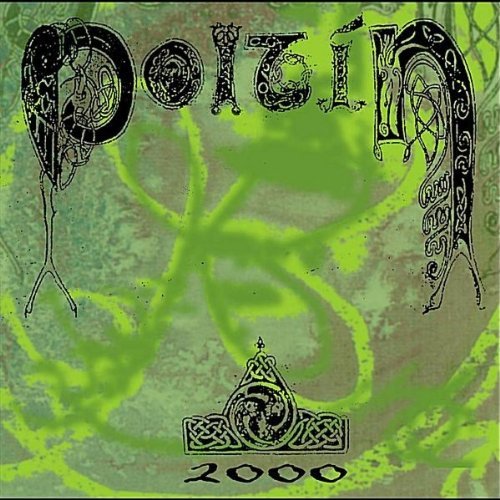
The first in the series of my album review featuring Celtic band from the Czech Republic. Poitin is indeed getting global attention and the proof is when their tune The Congress Reel appeared in Sherlock Holmes:A Game of Shadows.
The running sound of the bodhran during the opening of the track The Congress Reel is enough to drive one nuts with its irresistible beat and the breakneck speed on how the instruments are played. It is a thumping beat that won’t just let one sit there. You have to move to the music! Poitin have come a long way since this debut recording was released in the year 2000. Now they are getting a lot of attention all over Europe and the UK.
The cover artwork is designed by Jeremy King, the band’s lead musician/vocalist. This album is eclectic, combining music origin from Irish, Scottish, Breton and French. According to Jeremy:
‘It was the first time in a studio for most of us, and we were a bit apprehensive, but it didn’t take long for us to get to like the experience. The recording took three weekends, and the mixing a further two. Most of the instrumental tunes we recorded in one take, so if somebody messed up, we had to start again from the beginning- not a pleasant task! Some tracks went easier than others. For example, Vladar we got in one take and Laird of Cockpen in two. But on the other hand, Gloomy Winter’s Noo Awa’ must have taken about twenty attempts. Tyna had to drink gallons of some horrible throat gargle, but in the end I hope you’ll agree it was worth it!’
I like Jeremy’s sense of humor. And I think his way of taking things with humor is responsible for the steady climb of the band’s success not just in the internet but also offline as they have been getting responses all around. Apart from being a musician, he is also a great supporter of Celtic music in general. He doesn’t hesitate to post updates and also re post news from his online friends.
This first album is well made. All tracks are played in an excellent way considering that no layering happened here. All tracks are played live. The second song Gloomy Winter’s Noo’ Awa is a slow air with Tyna Frankova’s haunting voice. I love the presence of recorders in this album because it adds a Shakespearean essence to it.
Other favorites are Si Mors a Mort Breton track, Carolan’s Ramble to Cashell with its amazing harp playing that’s flawlessly delivered. Bodhran Solo from track 6 is powerful and though it is a short piece it stops you on your tracks. To be honest, there is no dull track here. Everything has been arranged carefully to create a balanced listening experience. I am an album guy and I prefer to listen to the entire album than just single tracks. I think the drama created during the ordering of tracks is just as important as the production itself. This album is a must for Celtic music fans and collectors.
Irish “tavern” tune from Sherlock Holmes: A Game Of Shadows score, used in fight scene during Watson’s last night of bachelorhood. Not included in the official soundtrack. Title: Poitin – The Congress Reel (recorded in 2000).
Tracks:
1. The Congress Reel
2. Gloomy Winter’s Noo’ Awa’
3. The Sea/Planxty Eleanor Plunkett/Planxty Maggie Browne
4. Si Mors a Mort
5. The Laird O’ Cockpen
6. Carolan’s Ramble to Cashell
7. Bodhran Solo
8. Grasou Mat Pier
9. Lover’s Ghost
10. TheDunmoreLassies/Trip to Sligo/Tom Billy’s No.2
11. Silvestrik
12. Vlada?
13. Carolan’s Draught
14. The Old Hag in the Kiln/Morrison’s Jig/Scatter the Mud
 Celtic Music Fan