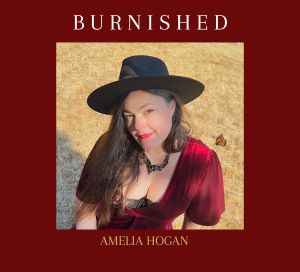
In the glowing tapestry of contemporary Celtic music, Amelia Hogan’s voice is a thread of bright, burnished gold. With the release of her latest album, Burnished, the San Francisco-based vocalist, instrumentalist, and producer invites listeners into a sonic landscape that feels both deeply rooted and enchantingly otherworldly. A spirited contralto whose voice radiates both clarity and character, Hogan brings timeless songs and stories to life with a distinctive, perky lilt that is as expressive as it is technically impressive.
At its core, Burnished is a meditation on place—both physical and spiritual—and the threads that connect us to the living world. Drawing from a wide geographic and emotional palette, the 14-track album includes traditional songs, contemporary folk reinterpretations, and one original track that stands as a joyful tribute to Hogan’s California home. With arrangements as vibrant and textured as the landscapes she sings about, Hogan doesn’t just perform these songs; she embodies them.
Her voice—a sparkling force with uncommon buoyancy—is the star throughout. Contraltos are rare in Celtic music, and Hogan’s particular timbre adds a grounding warmth to the high lilt often associated with the genre. Whether singing the mystical “Blue is the Eye” or the melancholic “Wayfaring Stranger,” she delivers each line with a grace that never loses its earthy joy. There’s a lightness and lift to her contralto, one that doesn’t dwell in shadow, but rather moves through the music like sunlight through ancient trees.
The album opens with “Rolling in the Gold,” Hogan’s only original composition on the record. It’s an upbeat, American folk-tinged tune with strong Irish traditional roots, celebrating the subtle, lived beauty of California beyond its material riches. With the delicate interplay of Celtic harp, mandolin, bodhrán, and layered harmonies, the track serves as an opening invocation—a love song to place and belonging.
From there, Burnished weaves through a rich mosaic of traditions and tones. Highlights include “They Call the Wind Maria,” rearranged to emphasize the elemental spirit of the wind as something that might be bargained with—a haunting approach that amplifies the supernatural ache at the heart of the classic American folk ballad. Her delivery here is intimate, reverent, and distinctly otherworldly.
In “The Snow Hare,” a modern Scottish composition reflecting on climate change, Hogan’s voice takes on a fragile urgency. The track’s delicate arrangement—built from mandola and mandolin—leaves space for her voice to shimmer, almost ghostlike, across the frozen terrain of the narrative. The perky rise in her vocal phrasing keeps the song from collapsing under the weight of its message, offering instead a sense of hope through awareness.
Then there’s “Home by Bearna,” a sprightly traditional Irish song about navigating home safely through the perils of night—both mythical and mundane. Here, Hogan’s voice is lively and impish, embracing the song’s winking humor with a wink of her own. Her phrasing dances with the melody, supported by rollicking fiddle and guitar that make it easy to picture the windswept Irish hills.
In contrast, “Who Will Watch the Homeplace” closes the album on a tender, aching note. Sung a cappella, it’s a powerful reminder of Hogan’s vocal command. Without accompaniment, her voice—pure, resonant, and achingly human—becomes the instrument. The piece encapsulates what Burnished does so well: bringing emotion and history into present focus through musical craft and spiritual presence.
The production, handled by Hogan herself at Foxtail Sound in Dixon, CA, is elegantly restrained, allowing the voice and traditional instruments to shine. Collaborators including Marla Fibish, Christa Burch, Maureen Brennan, and John Weed add sonic depth without crowding the space. Instruments like the Celtic harp, flute, mandolin, and shruti box are layered with care, each track feeling as if it has room to breathe and shimmer.
Thematically, the album resonates with animist philosophy—inviting listeners to imagine the world around them as conscious and sentient. Hogan’s liner notes speak of “spirits of place,” and that animating belief is felt in every track. The songs aren’t just sung; they are offered as living connections between the listener and the broader, often unseen, world. There is both reverence and play in how she interprets songs from Gordon Bok, Karine Polwart, and Trevor Peacock, never straying into sentimentality but always anchoring her interpretations in emotional truth.
Amelia Hogan has long been celebrated for her dedication to the sean-nós tradition and her international touring work, including her acclaimed 2023 album Taking Flight, which charted high on the Folk Alliance International Chart. But Burnished feels like a particularly personal and transcendent achievement. It’s not just an album—it’s an ecosystem of stories, a ritual of remembrance and renewal.
In the ever-evolving landscape of Celtic and folk music, Amelia Hogan shines as a voice of both tradition and transformation. With Burnished, she offers us not only a beautifully produced and richly performed album, but a way of listening that opens the ear to the land and the unseen spirits within it. Her unique style, both grounded and ethereal, is a gift that carries these old songs into the future with grace, joy, and shimmering gold.
https://ameliahogan.bandcamp.com/album/burnished
 Celtic Music Fan