Ryan McGiver :Troubled in Mind(Interview)

========================================================
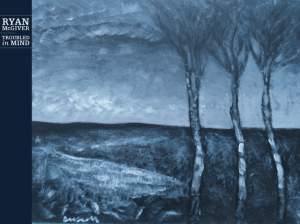
A few months ago I got acquainted with Ryan McGiver. We exchanged a little of conversation and I commented on how wonderful the album artworks are. Then I got to listen to the whole album and it literally blew me away. His music is very visual, atmospheric and beautiful. In his debut album Trouble in  Mind, he is backed by seasoned Irish musicians. According the blurb:
“Ryan McGiver’s debut album, ‘Troubled in Mind’, is a Indie-folk record of imaginative musical interpretations of old Appalachian ballads. Co-produced by Shahzad Ismaily (Bonnie ‘Prince’ Billy, Marc Ribot), the collaboration results in a spiritual, often meditative music, with a haunting quality that draws from sources as diverse as Buell Kazee, Washington Phillips and Randy Newman.”
The album includes guest appearances by an all-star cast of musicians including Jolie Holland, Doug Wieselman (Martha Wainwright, Antony and the Johnsons), Susan McKeown, Cillian Vallely (Lunasa), Stephanie Coleman (Uncle Earl), Jason Sypher, Cleek Schrey, Eamon O’ Leary, Cassandra Jenkins, Nick Reeb (King Wilkie), Jefferson Hamer, Pádraig Rynne, Patrick Mangan, Clara Kennedy, Matty Mancuso, Will Orzo and Howard Arn. Two beautiful horn and string arrangements were composed by Dana Lyn as well.
I did a little interview with him . It is now out in itunes. The physical release of the album is available on amazon.
=======================================================
1.Your album Troubled in Mind is a sonic blanket of somber beauty and Appalachian musings. Have you already made up your mind if this is going to be on a label or are you going the indie route?
Indie all the way. I had some offers from labels, but the way the music industry is these days, I decided to try my hand at a self-release.  The whole process has been, as with any debut, a great learning experience.
2. You work with big names in the traditional music scene.  How did you get these guys together?
The album is a collective of many musicians I’ve worked with over the past decade: some from my native Catskills; others I played music with while living in Ireland; another I met while working in Central Virginia; but most are musicians I know from my time spent in Manhattan – many I consider to be close friends.

3. The ballads here are hypnotic. What’s the concept behind this album?

I wanted to create a sort of sonic soundscape of my mind and surroundings through the lens of traditional song.  And to create a record that – in part- represents the beauty, desolation and sadness of growing up in Schoharie County, NY.

I’m drawn to music that is meditative and melancholic, whether traditional or contemporary in form. There’s something about a sad song that makes me happy. And I love music that is rich in texture, subtle layers and has lots of space.  Points where you can insert your imagination and fill in the blanks.  I always return to art – whether music, poetry, film – whatever it may be –  that has space and allows my mind, ideas to grow.

The songs come from all over  – Texas gospel, Old-time, Irish/English ballads, even a Randy Newman cover for good measure. “I Wouldn’t Mind Dying”, comes from a Washington Philips record that I got at a garage sale when I fifteen; “Farewell Dearest Nancy” comes from a Mick Haley cassette tape I wore out (who doesn’t love Moving Hearts?), “The Dying Soldier” came from a dear friend, Paul Strother, a clawhammer banjo player I labor with in the summers back home; “Tazewell Girl” was written by my uncle, Neil Driscoll – one of my big influences in music. Others songs came directly from pages in local libraries, one specifically,  “I’m Troubled, I’m Troubled”, from a collection called ‘Folk Songs of the Catskills’.  All have been important to me for various reasons over the years and I wanted to find interesting ways of recreating and retelling some of the more common ones.

4. You worked on the recording of this album for 13 months!  A lot of effort must have been placed on each track. How was the whole experience?

While working on ‘Singing In the Dark’ with the great Irish singer, Susan McKeown, I had the opportunity to collaborate with Shahzad Ismaily – a wonderful multi-instrumentalist and composer. We became fast friends and he agreed to co-produce the album after I had been working on it for several months. Honestly, I wasn’t very familiar with his music outside of our studio sessions, but felt overwhelmingly drawn to his personality and musical contributions in a studio setting. And the way we could make each other roar with laughter! Ismaily is an extraordinary talent. And an inspiration to work with.

The album took over a year to complete, because as you could imagine, there were many schedules to coordinate. Including my own, in and out of tours.  I  worked on it as if I was building a stone wall: slow and steady, taking moments to reflect and breathe – often standing back to take a look at the greater whole while working. I made the album for myself, so was under no time constraints.
Autoharp 101 Interview with Marc Gunn

Marc Gunn. Celtic Folk Musician (& Cat Lover!)

Answers from the Godfather.

I have been a Marc Gunn newsletter subscriber for as long as I started blogging.  He writes, performs and at the same time reviews Celtic music. One day I had this idea to drop these questions and see what comes out of them.  Read below:

1. How did you learn to play the autoharp?

It was 1997. My band, Breastfed, just broke up. I was playing mostly
punk, alternative, and grunge music. My songwriting was really bad.
I wanted to write better songs with more compelling melodies and
lyrics. However, I was limited by being a bad guitarist. I couldn’t
focus on good melodies when I had to focus on creating the right
chord. So I picked up the autoharp.

I took one of my dad’s autoharps to college with me. When the band
broke up, I picked up an autoharp songbook and started strumming. I
played these strums over and over again. When I felt I knew the strum,
I created my own patterns and I wrote a song.

Every morning as I walked to the Texas Department of Health, where I
worked, I had finger picks on and practiced strum patterns. Then I
went home and practiced them with the autoharp and wrote another song.
It worked great for me.

> 2. It looks like a complicated instrument but can you give us a closer look at the instrument? What are the things you learned about it and how do you start learning it?

I love the autoharp because it has a short learning curve. You can
start playing the instrument quickly. To play well… that takes a
bit more time.

It has five octaves. That’s amazing for most folk instruments.
However, it is limited by only 15-21 chord bars. That means if you
wanna play a diminished 6th, you can’t UNLESS you replace a chord bar.

My 21-chord autoharps include most of the major, minor and 7th chords.
When you learn to change chords quickly, you can play melodies on the
autoharp fairly easy. It takes time though.

I play with a lot of flourishes. My fingers dance on the strings.
That makes it look more complicated than it is. However, most
everything I learned about the instrument came from that Mel Bay
autoharp book. With time, you learn to hit the right string in a
chord while your fingers dance around the strings. It just takes
time.

But at the basic level, just press a button and strum.

> 3.Who are your vocal influences?

Elvis Presley was my first vocal influence… Well, actually probably
my dad. He was always good with voices. I can sing with my voice or
an accent imitating someone else. When I started playing Celtic
music, I listened to an old cassette of Irish drinking songs. The
singers were very nasally. So I started singing with a nasal sound.
Christy Moore was part of that early education as were The Balladeers
and The Dubliners.

My last band broke up in 2008. After that, I really started singing
with my own voice.

> 4. How many albums ave you released so far?

Ummmmmm…. A lot! My label, Mage Records, has well-over forty albums
to my various names, personae and bands. My old band, the
Brobdingnagian Bards, released 12 official albums. I have 14 that are
currently out. My latest is “Don’t Go Drinking With Hobbits”. It an
album hobbit drinking songs.

My success has largely been based on releasing a lot of music. I give
away a ton of music, for free in fact (see
http://www.marcgunn.com/folk_music/ ). I want people to hear my music
more than anything. Since I started doing that in 2000, I’ve given
away literally millions of MP3s. It’s pretty incredible.

> 5. You are an amazing media guy when it comes to spreading Celtic music awareness…can you share with us the tricks in keeping everything together?

LOL. Oy. I’m not sure. It’s never been easy. Google Alert is pretty
cool for that. For a while, I spent 60-80 hours per week doing all
aspects of my music business. I’m married with a baby now. So I
can’t do that any more.

Now days, I try to get as much help as I can. My Celtic Music
Magazine and Irish & Celtic Music Podcast are invaluable tools for
promoting Celtic music. Most Celtic bands come to me. I get press
releases and emails. The toughest part is organizing that information
so I can share it. I have a bunch of notetab files for that purpose.
Sometimes I remember.

> 6. What advice can you give me about maintaining my blog?

Blog often. Keep at it. Email any band you feature in it to let them
know they are featured. Ask them to post a link to your blog. Read
Problogger. (http://www.problogger.net ). I’m not sure blogging for
profit is possible in Celtic music… or least not much profit. But
it has some great advice for building a reader fan base.

Slainte!
Marc Gunn

======================================================

Cunla Band,It gets better and better!

Check this band out. I think they are awesome. Thanks to my friend Jimmy for posting these guys.

Cunla band plays traditional and contemporary Irish music, with a little pinch
of world music. Cunla are:

Ella Jackson Shlomi – vocals, Bodhran.
Elad Yifrah – flute, tin-whistle, accordion.
Oded Navon – guitar.
Ofer Groman – vocals, bodhran, uilleann pipes, tin-whistle.

=======================================================

Sharing songs

Now my friend Christi will have an idea where I also get my ideas.  Believe  me my friend Jimmy is a better scout  when it comes to Celtic music. I do wish Tim will start posting too so I can steal his ideas(wicked laughter).

Mick Flannery

Now this song from Eleanor McEvoy is not just compelling because of its beautiful acoustic arrangement, driven by the piano. It is also because of the lyrics to quote: It is a simple love song about not wanting to face life and wanting so much for someone to make it all better – “Will you be a harbour? / At my shoulder / Always watching over / Try to hold me closer / Shelter me and shield me from the world”.

========================================================

I featured Le Vent du Nord several moons ago and I am glad to be reminded of them and their brand of music once again.

=======================================================

Despite how outrageous the title sounds, it is actually an amazing show by The Friel sisters.  It says: The Friel sisters play a few tunes in the bathroom in the Hall in Milltown Malbay during Willie Clancy Week 2008.

======================================================

Now here’s Mick Flannery who reminds me a bit of Richard Harris-the guy who gained fame through the song McArthur’s Park. His voice has that vulnerability found in crooners and the confidence that is inherent in most Irish singers. I got to read his website bio and got a kick out it. He seems funny and doesn’t really care about fame and all that glitter. Just a guy who loves to sing his heart out and tell you his story through his songs. I think he is on my top list of male performers for this year.

Learn Celtic Fiddle with Gillian Boucher

Hi folks. Just discovered this wonderful fiddle musician/ teacher . I think my time on social networking sites like facebook exposed me to materials posted by other Celtic music lovers.  Like all best fiddle players that Cape Breton can offer, Gillian leads her pack like comets blazing the night sky of Celtic music. Fiddle playing has never been sweeter, infectious and explosive the way she does it. For those who are audience of Celtic Colors then you might have noted her performance from2008 to 2011. She already earned the Nova Scotia Music Week Award in 2009 for Roots Traditional Recording of the Year and an East Coast Music Award Nomination in early 2010 in the same category. Her playing is transporting and I can close my eyes and reach places in the mind that is not possible to access in the physical state.

This site http://gillian-boucher.com  lets you hear tracks from her album Elemental(2008).  She is working on a new album to be released this year.

I dedicate this post to my friend Nancie in Lyon France who is a fiddle player herself. I hope that one day I will hear her play.

Continental Celtic Music:Julien Jaffrès

========================================================

A certain  Alice Delsarte sent me links to sites of Julien Jaffrès. I am amazed by this man’s talent with the guitar.  He brings freshness and verve to the European  continental Celtic scene. He is worth checking out.


http://www.youtube.com/user/jjrockncelticguitar

http://www.julienjaffres.com/